
As political economists, we might be a bit too bold. We like to believe that political economy is the gold standard for economic analysis and reflecting about economic processes. While not every political economist might be that bold, at least as Marxists we see ourselves in the tradition of the “critique of political economy”, meaning today: critique of the economic (as well as the economics) status quo, which creates some potential for emancipatory change. How relevant is our critique, though, after all?
In fact, it might be the critique part that leads us astray. The central problem here is that we spend too much time thinking about all the different ways that capitalism structures social relations to the point that we do not get to the point of thinking about transforming these relations. The result is a serious limitation to the emancipatory potential of our critique – that is, the potential for non-capitalist futures. What use of a sophisticated critique, if we don’t have an idea of the way ahead?
My argument is that to get to this way ahead we should take inspiration from critical and discursive theory: taking seriously the fact that the social world is socially constructed, and thus open to change. While we might all be aware of this, we seem nevertheless stuck in the rigidity of our capitalist-centric theories. Instead of political economy, a move to a discursive economics might reorient us better towards emancipatory research.
Brings emancipation back to the table
This is an argument to constitute a new line of inquiry that we can call discursive economics. The goal is to combine the essential insights from critical theories with those from Marxist political economy. While the strength of Marxism is dissecting the intricate functionings of the capitalist system, critical theory sheds a light on the fundamental contingency of this system – and thus the possibility of transforming and overcoming it. This is not about creating new theoretical fault lines, where discursive economics would be on the one side and Marxist political economy, or critical theory on the other. Rather this is about showing the way of and motivating a new line of enquiry towards an emancipatory economics.
That would be an especially hard pill to swallow for Marxist political economists. Most commonly, Marxists are disgruntled about the shift away from material conditions in critical theories, which claim that language is more important in understanding social reality. Despite the feud, we share a central starting point: society is just a set of social relations. This means that economic, political, and other social processes have meaning and effect through social relations. Just as the construction of capital and labour means that the capital owner exerts power over the providers of labour. Put differently, capitalism — and society more generally — is a social construction.
The next step is to admit that these social relations are open to change. Again, not too hard to accept, since we know about the shift from feudalism to capitalism, or from corporatism to neoliberalism. Now, the point of having a new line of inquiry is to focus our attention on the economy as a social construction—one that we can transform. (We come already close to this in approaches that reconcile Marxism with critical realism) Thus, this possibility of transformation opens up the possibility for emancipation. This way a new line of inquiry, we can call discursive economics, refocuses our attention towards and thus contributes to emancipation.
Marxist political economy has no way forward
This may sound self-evident. Yet, we are not taking this seriously. In our research we are merely considering the construction of the current status quo (and its historical genesis). And this is the central weakness: we are not giving an outlook of possible avenues out of it. The easiest target for this critique is what some call orthodox Marxism, or what Gramsci called economism: all social processes are in the service of and completely pre-determined by the capitalist economy. This critique alone gives little direction (other than despairing about the bad shape of the political parties that bring these positions forward).
But also more contemporary political economy falls prey to this line of thinking. Take social reproduction theory: domestic activities are unpaid work enabling the accumulation of capital. An important critique of the ways that capitalism is structuring family relations – but with little analysis on how to move away from this. One example for this is the excellent anthology by Bhattacharya, collecting perceptive analyses on the dynamics between the spheres of production and social reproduction under capitalism, encompassing the household, childhood, state policy, migration and so on.
However, only one contribution of five pages at the very end explores explicitly anti-capitalist movements. Even then, the focus is more on resisting capitalist subordination rather than systematically exploring breaks with the capitalist logic. A discursive economics would encourage an exploration of these breaks for non-capitalist practices and imaginaries, which could pre-figure an emancipatory organisation of production and reproduction. A prime example for this is Nadasen’s book on the care economy, who not only retraces capitalist subordination, but also highlights collective practices of care based on solidarity and the common good.
More generally however, research in political economy offers little of a positive vision other than struggles of resistance within capitalism. While our theories give us magnificent tools to critique capitalism, they stop short of imagining anything other than capitalism, they stop short of imagining anything beyond it.
From research to emancipation in discursive economics
A commitment to discursive economics, that is starting this new line of inquiry, can provide the way forward. In discursive economics we would shift our attention to the ways that social relations can be transformed to achieve emancipation. And actually, Marxist political economy provides a robust starting point for this. Already now we are analysing the cycles that feed into the logic of capitalism, as well as contradictions to it. In discursive economics we would emphasise the importance of the latter: when observing a break with the capitalist logic, we examine the fissure and how it may contain potentially emancipatory social relations.
The discursive aspect is central to this approach, because it emphasises that social relations are always provisional and open to transformation. It also emphasises agency: the transformation of social relations can be effectuated through the people previously subjected to them, given favourable conditions. Discursive economics would also give more agency to researchers, who can actively contribute to a conducive context by exploring the potential of non-capitalist social relations within these fissures. The researcher is not a critic, but a participant in a joint project for emancipation (accordingly, we can take inspiration from the ethos of participatory research methods).
Doing away with misconceptions
At this point, it is important to explicitly address the most common qualms that Marxists political economists have with critical and discursive theories. The elephant in the room is: the role of capitalism and the pretence of knowledge. Firstly, it should be clear that the analysis of capitalism should be central to a discursive approach. Since the goal is to analyse economic processes, it is central to acknowledge the organising force of the capitalist logic in shaping society, absorbing other social processes to the benefit of capital accumulation.
Secondly, while there is a valid concern in the Marxist tradition on abstaining from any dictate about what society after capitalism might look like, too much agnosticism might actually be harmful. This is because political organising needs some goal to have energy. Why else invest energy for political organising, if the goal down the line is so diffuse? The point is to move away again from a Marxism as mere academic exercise of critiquing capitalism towards a research approach that can be a resource for overcoming capitalism.
Economics as tool for emancipation
The central takeaway is that we are too bold and yet not bold enough. As political economists we are very satisfied with our much more perceptive approach vis-à-vis mainstream economics – yet we don’t dare to use our research to explore possible futures beyond capitalism.
The point of starting a new line of inquiry, namely discursive economics, is to combine the strengths of Marxist and critical theory: uncovering and critiquing dynamics of capitalism to discover breaks that reveal potential for a non-capitalist future. We should not be comfortable with using our research and theories purely for critique, since we get stuck in capitalism. When we shift our attention also to the pockets of the non-capitalist present, we can contribute to a growing non-capitalist future. In this way, discursive economics makes political economy emancipatory.
Thabo Huntgeburth is a PhD candidate at the Economics Department of SOAS, University of London. His research interest is in the political economy of institutions and labour regimes in an imperialist world-system, as well as prefigurative potentials of worker-managed cooperatives.
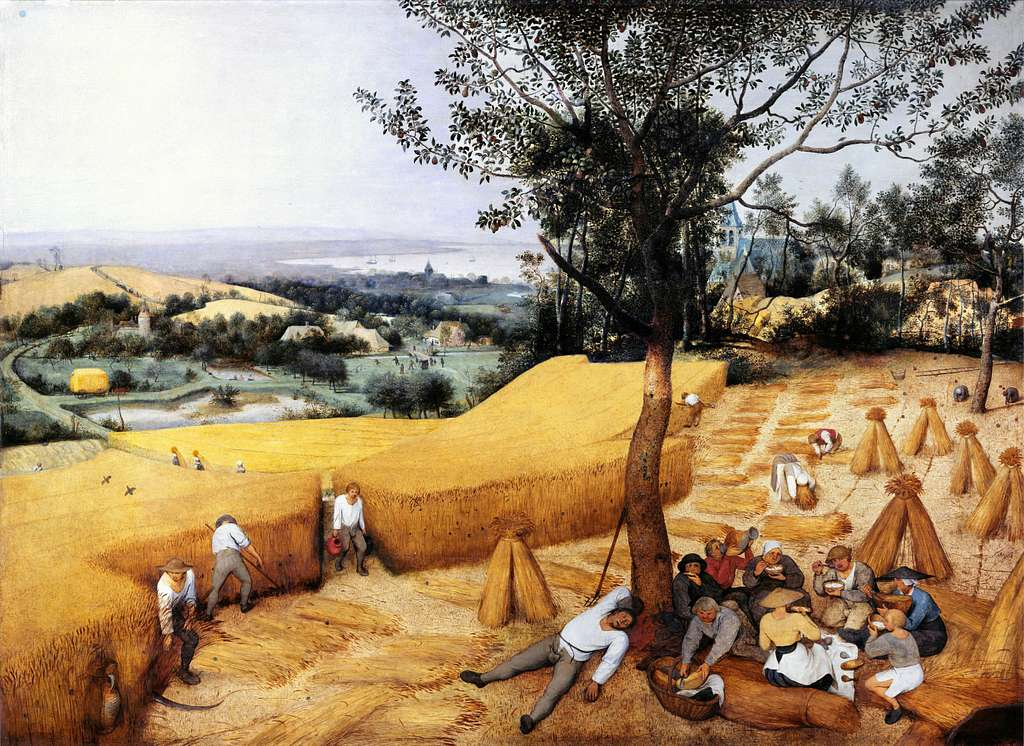
Image: Harvesters, Pieter Burger, Google Cultural Institute via Picryl.com