
Election night was a disaster for Democrats. But contrary to what some pundits will tell you, it was not a defeat for “the left” as a whole. Despite the rightward national shift, democratic socialists still found success in races across the country.
The Democratic Socialists of America won all six of its nationally-endorsed campaigns on election day, including city council victories in Maine and Oregon, a living wage ballot measure campaign in Everett, Washington, and a state legislative race in Delaware. Earlier this year, DSA-endorsed candidates won primaries in conservative-leaning Kentucky and Georgia, who went on to win easily in the general election.
Across all of its nationally-endorsed campaigns, DSA had an impressive overall “win rate” of 59% in 2022 and 69% in 2023. This success is a puzzle. How have democratic socialists been able to keep winning through the Trump and Biden years, while other left-wing parties like the Greens have stayed marginal? In a new article in Interface, a journal for social movements research, I try to answer this question.
Between 2018 and 2021, I carried out participant-observation fieldwork with the Portland, Oregon chapter of DSA. I wanted to understand why DSA chapters were popping up everywhere and finding success in electoral and social movement campaigns. I found that socialists in Portland, like others around the country, were consciously trying to create a new kind of organization, one that avoided the pitfalls of both top-down nonprofits and “horizontal”, Occupy-style groups.
DSA’s breakthrough in these years was in rediscovering the idea of membership-based politics for the left, in which ordinary people can have a meaningful voice in an organization that they control. DSA’s empowered, confident membership is its secret weapon, giving it both an autonomous funding base and a formidable mobilization machine for its endorsed candidates.
The power of an engaged membership was on display in Portland this month, when DSA’s two endorsed candidates triumphed in an enormous field for city council elections. Portland DSA members were the core of an “unrivaled” ground game that knocked over 26,000 doors for the two campaigns. Even Willamette Week, the city’s hipster neoliberal rag, now feels compelled to place Portland DSA second in its power rankings for the new city hall.
Beyond the NGO and affinity group
To understand what makes DSA’s style of organization successful, it helps to understand the organizational models that socialists did not choose to pursue in the pivotal years following 2016, when the Bernie Sanders campaign inspired tens of thousands of people to become democratic socialists.
The landscape of the American left in the mid-2010s was broadly dominated by two kinds of organization. On one side was the liberal “advocacy” nonprofit. This kind of organization is usually nationally-focused and based in Washington, D.C. or New York, has a non-elected board of directors, and focuses on legal action or lobbying political insiders to win small reforms in a specific issue area.
For their part, radical left activists have tended to prefer a form of organization that is horizontal and committed to “direct” forms of action, participation, and deliberation. This type of group would often become prominent for short bursts during big social movements, like the Alter-Globalization Movement, Occupy Wall Street, and Black Lives Matter.
The advocacy nonprofit and horizontal movement group differ in important ways. The former accommodates itself to the system, while the latter is radically opposed to it. But they share one thing in common: neither is very open to participation by ordinary people. Put another way, neither kind of organization can support meaningful, sustainable forms of membership.
NGOs aren’t interested in involving lots of people as empowered members. Their constituencies are upper-middle class people who would rather cut checks than attend meetings. Organization builders from the professional class prefer to allocate leadership on meritocratic criteria of expertise, not election by the rank-and-file.
Horizontal collectives, on the other hand, usually want to engage lots of people. In rare moments of heightened social struggle, large numbers of ordinary people—people who wouldn’t normally consider themselves “activists”—can suddenly find themselves on the barricades and getting involved with ad-hoc protest groups.
The problem is that horizontalism is deeply uncomfortable with mediation. “Structureless” groups do away with formal rules and divisions of labor. But this has the unintended effect of empowering an “aristocracy of activists”, those who can devote the most time and energy, at the expense of ordinary people.
For advocacy nonprofits, participation is thin and desocialized. For horizontal movement groups, it is intense, dynamic, but unsustainable. While both political forms can “get the goods” in particular circumstances, neither are capable of generating and nurturing strong and lasting collective identities. Neither can support democracy for busy people.
But between the superficial engagement of nonprofits and the all-or-nothing commitment of the affinity group exists other possibilities. It was these alternatives that Sanders-inspired socialists turned to when they joined DSA.
The heritage of membership-based politics
In her classic book Diminished Democracy: From Membership to Management in American Civic Life, political scientist Theda Skocpol unearths a forgotten tradition of membership-based civic life in the United States. Groups like the Masons, Odd Fellows, and the General Federation of Women’s Clubs organized huge numbers of Americans for a wide range of civic purposes. Between 1810 and the 1990s, organization-builders constructed 58 voluntary associations or federations that enrolled 1% or more of U.S. adults as members.
These “fellowship associations” held national conventions using elaborate democratic procedures and rituals, and had formal divisions of labor that relied mostly on the contributions of volunteers. Most important, they were rooted in state and local chapters that held regular, face-to-face meetings. The largest groups had over 10,000 chapters, each with officers, committees, and a vibrant social life.
It’s important not to romanticize the associational tradition. As the sociologist Dylan Riley argues, a densely-organized civil society is itself a terrain for hegemonic political struggle between left and right. In the United States, mass member voluntary organizations could be exclusionary, nationalist, and racist, and had an ambiguous relationship to class struggle.
But as Skocpol demonstrates, popular associations could also be schools of democracy, giving ordinary people opportunities to develop skills as leaders and organizers. Some associations had important roles in incubating major social movements like abolitionism and the civil rights movement.
When I began my research in 2018, DSA was not just gaining members but, crucially, was gaining chapters where these members could meet and build community together. By the end of 2017, there were more than 300 local DSA groups spread around the country, operating with minimal support from a small national staff.
Navigating life in Portland DSA, I could feel echoes of the associational tradition. Members deliberated using Robert’s Rules of Order. They agreed on a formal division of labor to manage work, and elected leaders to speak for them and represent their views at the national DSA convention. Monthly meetings were even held in a historic Freemason lodge built in the 1920s.
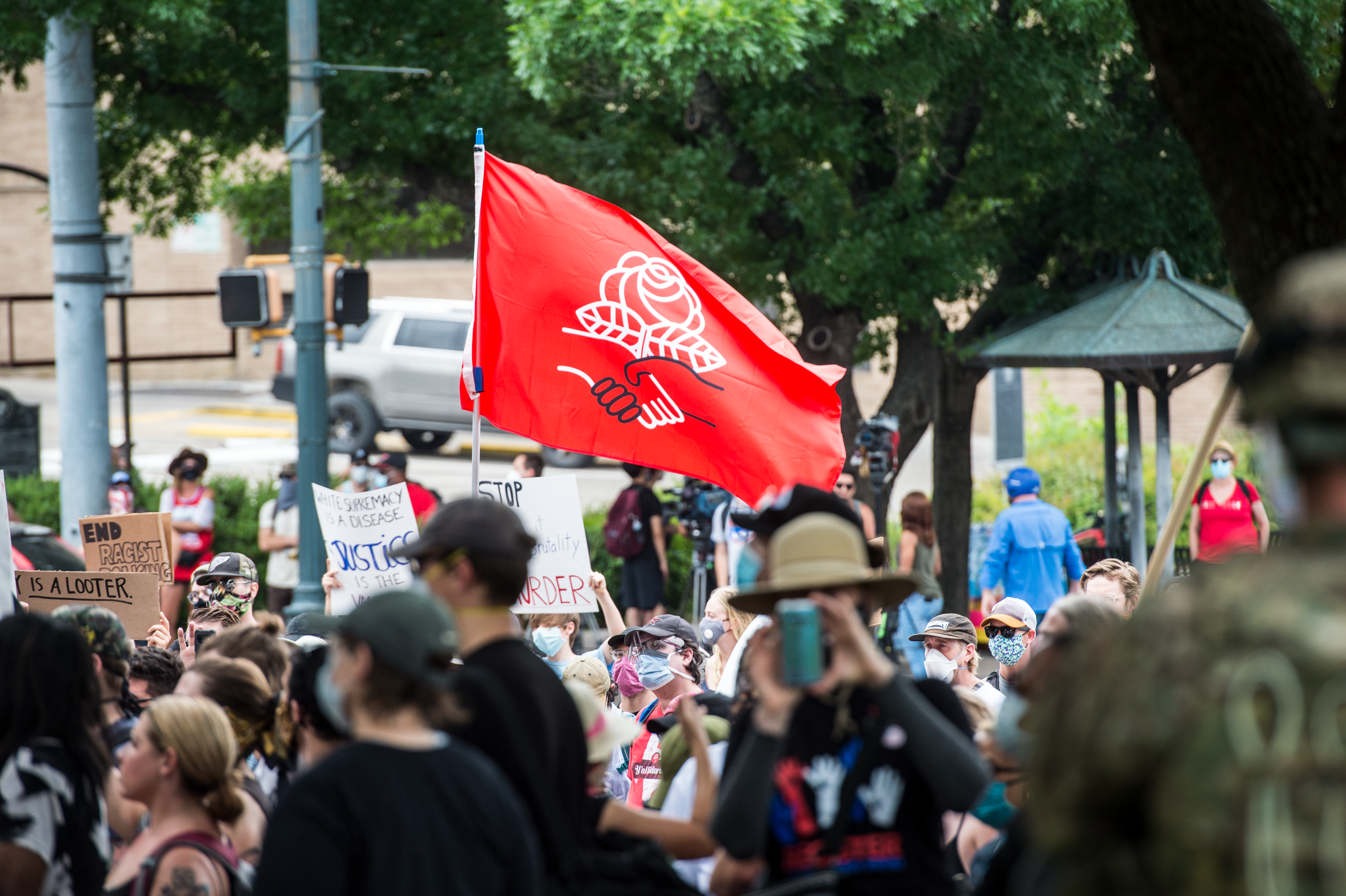
Members identified with past and present symbols of the socialist movement—the red flag, the rose, hammers and sickles—mixed with symbols of local Portland pride. And with the help of a “socialist public sphere” on Twitter, local members could feel a sense of common identity with DSA members around the country. I could also see chapter members working to build social and cultural infrastructure reminiscent of the old associations. Members organized regular socials, house parties, and river floats, and there was a recognizable “scene” that overlapped with chapter life.
It was difficult for me to imagine all this occurring in a nonprofit where members listen politely to staff sent from the national office, or in a movement group focused exclusively on planning the next rally or protest. It was possible only because DSA members had found a sustainable middle ground of political activity, balancing structure and routine with radicalism and energy.
But while the communal aspects of Portland DSA were important, life in the chapter was fundamentally about politics. Instrumental, not expressive, action was the order of the day. Portland DSA members spent most of their time debating how they could build power for socialism, in the workplace, the streets, and the state.
While I met many DSA members who appreciated the similarities between the organization and old-school voluntary associations and churches, the organizational model that most members aspired to emulate was the membership-based party. During my fieldwork, Portland DSA hosted visiting representatives from Momentum in the UK and Morena in Mexico, quizzing them on details of party structure and strategy.
Local members also took up national political questions facing DSA, like the contentious 2019 decision to endorse Bernie Sanders months before a national convention. Members felt that these decisions had real stakes, and organized each other into factions to lead the chapter one way or another. In other words, member participation was inseparable from internal democracy.
The ideal of a participatory socialist or labor party with deep local roots and internal party democracy has a deep appeal in an age of “hollow” politics. Scholars like Peter Mair and Suzanne Scarrow have documented the long-term decline in memberships in European party systems that once included important roles for rank-and-file members.
To a greater extent than other left “movement parties” that emerged in the 2010s, DSA has centered the idea of an empowered, educated party membership, and placed less stress on charismatic “hyperleaders” or online platforms that substitute for face-to-face relations between co-partisans.
Empowering the middle-members
Through my interviews with Portland DSA members and observations of chapter life, I came to the conclusion that DSA’s membership-based structure had opened the door to a novel kind of political participation on the U.S. scene, one that is structurally unavailable for horizontalists and undesirable for nonprofits. This is an important step forward for the American left.
But the outward appearance of vibrant participation concealed a weakness. For all of the vitality I saw at general member meetings, social events, and protests, it was also clear that only a small fraction of the chapter’s total membership—around a thousand socialists!—were actually being engaged. Most members remained “on-paper.” Meanwhile, a core group of “activist-cadre” devoted many hours to leading chapter committees and carrying out the thankless labor of scheduling meetings, preparing agendas, and fine-tuning bylaws.
What seemed possible, but only intermittently realized, is what I call an “effective but non-intensive” form of participation for an intermediate layer of members, those who are neither “paper” nor “cadre.”
These members would possess knowledge of organizational politics and procedure sufficient to feel ownership over the party on an equal footing with the most engaged activists, without themselves devoting an unsustainable amount of time to party work. Cultivating this form of middle-membership is especially important for time-burdened working-class members and parents with children.
How can DSA (and other membership-based organizations) sustain this middle-membership layer? I suggest three ideas. First, middle-members benefit from a robust infrastructure of intra-organizational media—party journals, podcasts, blogs—that can counterbalance the informational advantages that cadres get from their dense personal networks.
Second, intermediate members need cadres to be organized into open political tendencies or caucuses, so that intra-organizational conflicts are fought out on clear political lines, not through informal and unaccountable cliques. And third, middle-members need to be engaged by consistent, well-structured campaigns that give ordinary members the opportunity to be ambassadors for socialism out in the world beyond the party.
We can’t build democratic socialism without a mass party—a party home to hundreds of thousands of working people, connected to millions more in labor unions, tenant associations, and community organizations. These parties are the only organizational form that has ever seriously challenged capitalism.
Our success or failure in building them hinges on our ability to create forms of party membership that are inclusive, effective, and meaningful, but not so intense as to be all-consuming and unsustainable.
David Purucker is a member of the Young Democratic Socialists of America and a graduate student studying sociology at the University of Oregon.
To read more about this research, see “Reviving the mass organization for social movements? The meaning of membership in the Democratic Socialists of America”, pre-print in Interface: A Journal For and About Social Movements, 15(1).