
Since Trump’s victory in the November elections, there has been no shortage of variations on Marx’s famous line in The Eighteenth Brumaire: “Hegel remarks somewhere that all great world-historic facts and personages appear, so to speak, twice. He forgot to add: the first time as tragedy, the second time as farce”. Given the outrageous promises he made during the presidential campaign (deporting millions of immigrants, imposing tariffs, threatening to jail journalists and political enemies) as well as the shape his new administration is currently taking, this interest in comparing Trump’s two terms is understandable.
There is a similar inclination among the left to compare the anticipated second round of social opposition to the course this opposition took during Trump’s first term. This is probably because of the eerie silence among the activist circles to Trump’s second coming, given the intense social mobilization against his rhetoric and policies in the aftermath of the 2016 election. Back then, “not my president” rallies which were spearheaded mainly by college students and activists had popped up in many corners of the country immediately after the election. The Women’s March of January 2017, which took place one day after the inauguration ceremony, became the largest single-day protest in the history of the US. Climate march, science march, pro-immigrant protests, and other high-profile rallies kept activism was loud and alive throughout the whole presidency. Despite that a “People’s March” is planned to take place a couple of days before the January inauguration, some describe the current lull in mobilization in pessimistic tones – that the overall feeling among the activists seems to be exhaustion, if not resignation, as they see “nothing has come out of their efforts” to avoid all this. Others (hopefuls) believe that “the movement” may have learned from its mistakes, what fractured it in the past, and is now more mature and developing new strategies to oppose the new administration.
But this binary mode of thinking rests on a false premise when it comes to understanding what contemporary social movements are about, what they aim for, or how to determine their success or failure. In my book, Gezi: The Making of a New Political Community in Turkey, I propose a new perspective that sees these movements not as mere resistance of the masses against those in power, or the ideas they represent, or the policies they implement, but as an expression of a desire for deeper and longer transformation to protect and reconstitute the ‘social’ against the assault of neoliberalism. While Gezi primarily focuses on the birth and subsequent trajectory of radical activism during the 2013 Gezi Park protests in Istanbul, there are lessons in this captivating story for students of social movements to reckon struggles against authoritarian forms of neoliberal capitalism.
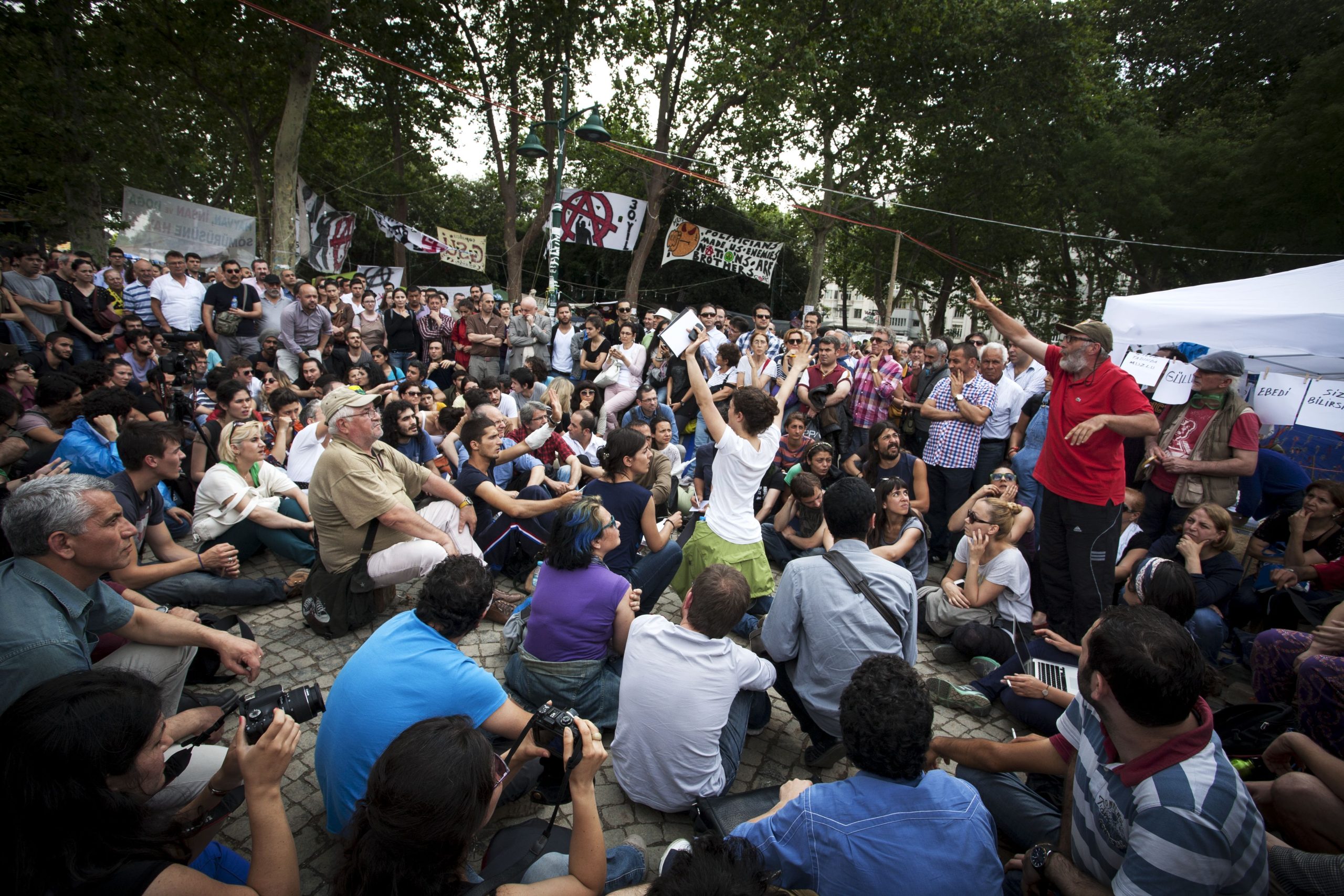
The Gezi uprising broke out at a time when the AKP government and its leader Tayyip Erdoğan were implementing policies of neoliberal urbanization in full force, this time by laying their eyes on a small promenade at the heart of Istanbul to open it up for the construction of a shopping mall and a high-end residential complex in service of global capital. What appeared at first to be a protest by a handful of environmental activists to protect a public space became one of the greatest rebellions in modern Turkish history. In Gezi, instead of focusing on the success or failure of intermittent protests, rallies, and other forms of issue-specific confrontation triggered by the attempt to flatten a park, I stitch together seemingly fragmented bursts of social reaction into contiguous and overlapping processes of political activism to emphasize their constitutive characteristics in the face of neoliberal destruction. The book highlights a special politics emerging from this activism, one that prefigures radical practices of democratic citizenship during what I call the “Gezi Episode” – a period that extends from the time of immediate clashes at the park to when forums and assemblies lose their relevance in the political imagination of the public. As such I aim to foreground how activists (scattered in different park forums, neighborhood solidarities and other local associations, having first clashed with police in the streets) imagined a different political community, and “practiced future in the present” with their everyday actions, even when they appeared to be “dormant” or “defeated”. Yet, instead of assessing the protests based on their proclaimed goals or the effectiveness of their strategies, I identify three distinct yet inextricably connected modalities of activism that I believe reveal the transformative character of contemporary social movements.
The first of these modalities, which I call mobilizational dynamic, concerns the constant state of globally-connected activism that motivate activists continue pursuing their goals, be them for recognition, democracy, ecological survival, or for fighting against economic inequality and dispossession. This process of politicization during the Gezi Episode normalized street activism and created a collective identity among participants, evolving them from occasional protesters to committed citizens in solidarity who eventually grew increasingly conscious of their agency, and could bridge their fragmented grievances for a shared sense of purpose in multiple groups and networks simultaneously. As time passed, rather than being demoralized on the lack of immediate political results for their activism, they gained more self-confidence, feeling part of a broader community committed to building something new.
The second modality, which I call spatial dynamic, draws attention to urban spaces where neoliberal (and always authoritarian) policies are most acutely felt but also where these policies are vigorously contested through various forms of activism in distinct settings. In Gezi, for instance, I demonstrate that it was this spatial variety during the Gezi Episode which allowed spaces like balconies, subway stations, squares, parks, neighborhoods and squat houses become sites of dissent, uniting diverse groups such as environmentalists, urban outcasts, and the white-collar precariat. In any of these settings an activist could assume overlapping roles such as a protester at a rally, a forum participant at a park meeting, a resident at a squat house, or a member of neighborhood solidarity group, all of which allowed the said activist develop diverse political subjectivities in connection with others. These interactions fostered an alternative form of solidarity based on the political potential of these spaces, creating a microcosm of a new political community within the city’s fragmented yet interconnected landscape.
Third and finally, the radical democratic dynamic of social movements is as much about the way activists are mobilized as what they mobilize for. This dynamic reveals the prefigurative characteristic of activism in which activists gather in assemblies where they adhere to the principles of horizontalism, pluralism, deliberation and consensus-driven direct action without a central structure or leadership. Political activism is conceived and enacted in different spatial settings as to defy conventional electoral politics as the sole expression of collective will. In Gezi I offer examples of a similar radical democratic experiment which took place in different corners of Istanbul where both national issues and local concerns were addressed, such as school closures, environmental degradation, gentrification, or increasing authoritarianism. I demonstrate how, in the process, activists as well as residents found themselves collectively tackling shared problems, fostering solidarity and a sense of community at the city’s commons such as parks, barter bazaars, free kitchens, community gardens and libraries, all the while challenging authoritarian and exclusionary neoliberal policies of the government. At the core of this activism lies a radical democratic vision to rebuild the economic (through pooling resources to meet the fundamental needs of all), political (through democratizing decision-making mechanisms), and social (through adopting an inclusive definition of community) pillars of a non-capitalist world.
But how is all this relevant to our anticipation of political activism in the second Trump era?
Bringing to the fore these three interrelated dynamics of contemporary social movements paints a different picture than the one that often clouds our political vision with such binaries as failure/success, defeat/victory, or loss/win. One lesson I learned while writing Gezi is that expanding our political imagination beyond what is (or is not) happening in the present helps us avoid being paralyzed by despair and appreciate the progress social movements achieve in the long run. A similar analysis of political dissent in the current American context may necessitate expanding the time frame and construct a “Trump Episode” as a continuum not divided but rather shaped by a “Biden interregnum”, and one which focuses on the potential of all forms of activism throughout his previous and upcoming tenure as a whole. Such a broad canvas captures the many ways through which the slowly brewing movement is weaving the social fabric into a new political community, and allows us to contemplate its “world-making” potential: that by blurring the line between community-making and rebellion, the movement is – what Ruth Wilson Gilmore calls – a ‘rehearsal’ in prefiguring and gradually building a new world against multiple forms of impending repression by the state apparatus. Rather than simply resisting the political establishment and its puppets, activists are actually building this new world through practices ranging from occupations, cooperatives, mutual aid and care networks in solidarity with immigrants, unhoused people, trans individuals, incarcerated people, women seeking reproductive care, and through many other campaigns to prevent the expansion of systems of dispossession and coercion at home and abroad. This is why no matter how disorganized, ineffective or even dysfunctional they may appear to be, all these acts of dissent are in fact precious incubators for a better future.
Kaan Ağartan teaches sociology at Framingham State University. His current research focuses on the relationship between racial capitalism, social movements, and radical democracy. His recent publications include Gezi: The Making of a New Political Community in Turkey (Edinburgh University Press, 2024) and (with Camilo Tamayo Gomez) Reimagining Radical Democracy in the Global South (Cambridge University Press, 2025).
Image: Cover photo from Gezi: The Making of a New Political Community in Turkey by Kaan Ağartan, published by Edinburgh University Press (2024).