

On the eve of New Year’s Day 1900, Frank P. Walsh (1864-1939) reflected on his life and decided a major change was in order. At thirty-five years old he had an expanding family and thriving career in corporate law. After growing up in extreme poverty in an Irish-American section of St. Louis, Walsh clerked at a law firm in Kansas City and studied hard to pass the bar exam with almost no previous formal education. He had dropped out of school when very young after his father died in order to support his mother. And now, living in a mansion and surrounded by wealthy and powerful friends, he could not square his childhood with the lifestyle of a corporate flunky.
By 1919 there was not another figure in the US more renowned or unifying for rank-and-file trade unionists, socially diverse industrial unionists, socialists, and anarchists. In dramatic fashion Walsh had exposed and embarrassed John D. Rockefeller, Jr. for his role in the 1914 Ludlow Massacre in Colorado through the Commission on Industrial Relations, and then convinced President Woodrow Wilson to establish the eight-hour day for 400,000 railroad workers in 1916. Walsh almost single-handedly created a worker-friendly labor control system through the National War Labor Board during the summer of 1918, which anticipated the 1935 Wagner Act-style of collective bargaining and briefly ignited industrial unionism. Throughout 1919, Walsh became a lightning rod for Irish nationalism in the US and Ireland, inspiring representatives of India and Egypt to seek his counsel in kicking the British out of their own countries during Versailles treaty negotiations.
Figure 1
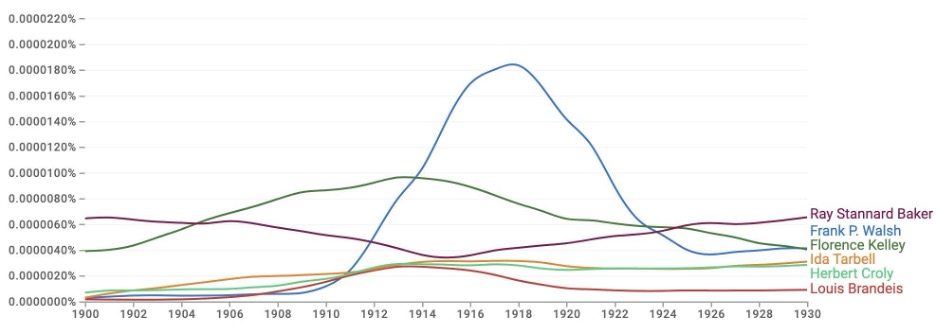
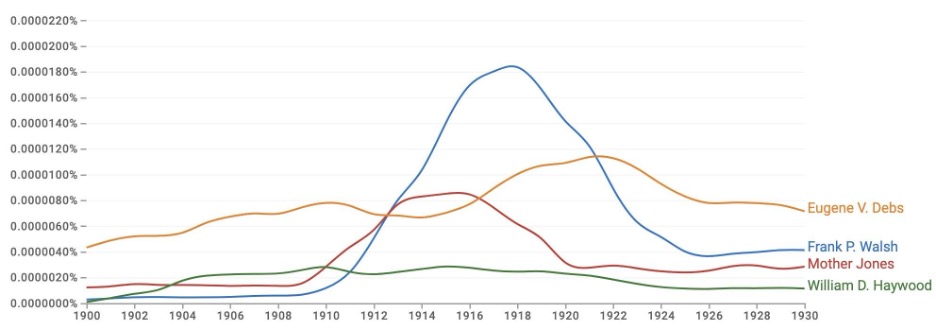
Figure 2
It would have been inconceivable in the 1910s that Frank P. Walsh would not be remembered as a central figure of the Progressive Era. And yet, Nell Irvin Painter’s indispensable grassroots narrative of the Gilded Age and Progressive Era contains no reference to Walsh whatsoever – despite devoting three pages to labor and Wilson’s 1916 reelection campaign, and references to the National War Labor Board on four pages, both topics in which Walsh had a direct hand. This is but one of many examples that leave Walsh out of Progressive Era history.
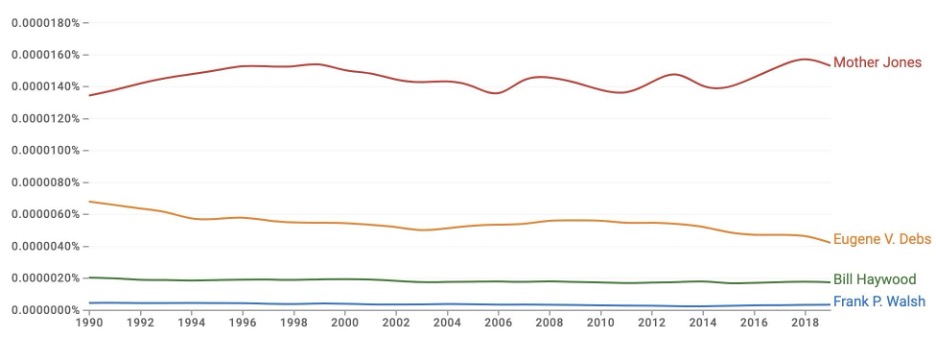
Walsh’s significance has been emphasized by historians Graham Adams, Jr., Valerie Jean Conner, David Montgomery, Melvyn Dubofsky, Joseph McCartin, Julie Greene, and Shelton Stromquist. However, according to Ngram, a search engine utilizing all printed sources in the Google Books database, Walsh received more attention during the 1910s than figures such as Louis Brandeis, Florence Kelley, Ida Tarbell, Herbert Croly, and Ray Stannard Baker (Figure 1); as well as Mother Jones, Bill Haywood, and even Eugene Debs (Figure 2). These are all people more frequently contemplated today (Figure 3 & 4). (Note: for people who have multiple variations of their name, I used the most commonly printed variation within each time frame).
Figure 3
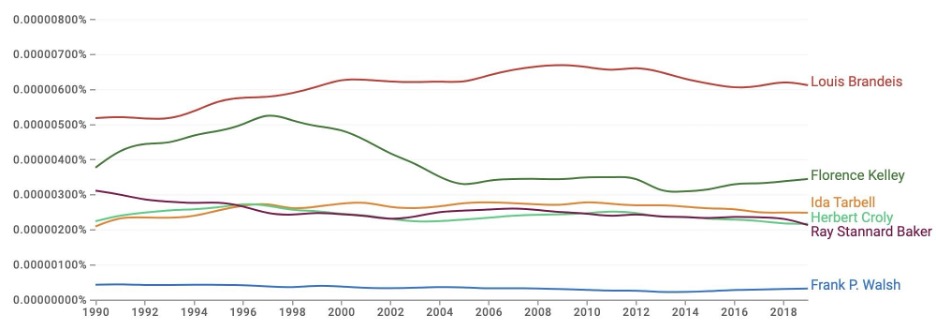
Figure 4
Why has Walsh’s place in the Progressive Era been so overlooked?
The explanation is tied to Walsh’s political strategy of radical agitation from within the halls of power and state legitimacy, while consciously remaining aloof from the internal struggles of labor and leftist organizations. Utilizing Gramsci’s distinction between traditional and organic intellectuals, I explore Walsh’s activities in an article in New Politics.
From a Marxist standpoint, class struggle occurs through the leadership, alignment, and articulation that brings together potentially disparate social forces in order to advance the interests of capital or the working-class. Within this process, intellectuals sometimes play an important role. Intellectuals can include professors, journalists, partisan strategists and spokespeople, lecturers, or, today, online streamers. Intellectuals can originate and popularize the framing of public issues in a way that subtly or dramatically increases the influence of one side of the class struggle.
According to the Italian Communist Antonio Gramsci, there are two basic forms of intellectuals, regardless of the content of their ideologies. A traditional intellectual is one who guards their sense of independence from outside influence. They think of themselves as freethinkers who use their brain power and sense of moral consistency to seize on the fundamental causes of, and prescriptions for, society’s ills. An organic intellectual, in contrast, has direct organizational ties to class-based interests. They participate in the internal politics of relevant social forces as members of organizations. They may also have explicit roles as spokespeople of organizations, which exert some control over the organic intellectual’s public-facing speech.
In the social sciences a case study can have theoretical significance if it is an extreme case. In my essay I argue that Walsh is an extreme case of a pro-worker intellectual pushing both insider tactics and modern agitation methods to their limits within a relatively conducive political context of accommodation to the labor movement. No other agitator in US history has been so successful at pushing worker-friendly policies via an insider strategy and media savviness. Walsh’s story, therefore, highlights for the labor-left the outer limits of what can be expected out of such a strategy.
As a traditional intellectual who spent much of his time with Democratic politicians, progressive intellectuals, and government bureaucrats, Walsh acted the part of interlocutor between the Democratic party and a rebellious working-class, including for the socially diverse proletariat spurned by the American Federation of Labor trade unions. His success in pushing the country left stemmed from his rejection of opportunism and willingness to anger liberals and politicians on his right when necessary. When right-wing forces ramped up anti-union and anti-left policies and propaganda at the end of Wilson’s second term, Walsh was discarded and forgotten by liberal politicians and historians.
In late 1918 and 1919, Walsh had the opportunity to jump into independent labor politics with the formation of a labor party in Chicago by industrial unionists. This was an opening for Walsh to pivot away from the Democratic Party and contribute his considerable skills to the internal organizing efforts of the working-class. This path could have led Walsh toward organic intellectual status, whereby he contributed to strategic decision-making and held to some form of organizational discipline. Such a move could have helped maintain his status within the collective memory of the American labor-Left. Instead, he has largely been forgotten, or even dismissed as a corporate liberal, as historian James Weinstein inaccurately characterized him.
The forgetting of Walsh, in other words, is a result of his tragic failure to get more involved in the messy internal politics of the labor-Left when the political opportunity structure became extraordinarily hostile to the working-class.
Jeff Stilley is an Instructor in the Department of Sociology at Virginia Tech. His research explores dynamics of working-class formation in the Kansas City labor movement of the 1910s, including the 1918 general strike in solidarity with white and Black women laundry workers.
Image: Frank P. Walsh, author:unknown. available at https://commons.wikimedia.org/wiki/File:Frank_P._Walsh.jpg