
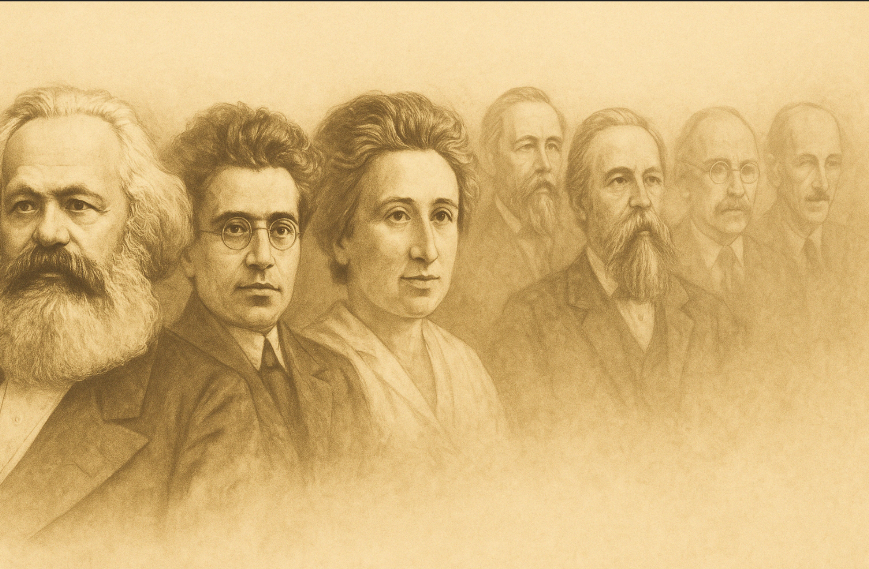
Paul Gomberg’s piece published on April 15, 2025, titled Why Activists Need Critical Communism appeared in my inbox this morning. He rightly alludes to many things the left, at its most noble phase of self-knowledge, ought to find reasonable — and ideally, second nature: the tradition of self-criticism, the willingness to re-examine history, and the refusal to calcify either our knowledge or ourselves. Professor Gomberg strikes a balance between the orthodox followers of — and the reflexive discarders of — Lenin and Mao.
The suggestion toward “from each according to his commitment” is an interesting rallying cry (my interpretation). It proposes that in the transitional period toward full communism, a vanguard of self-sacrificing individuals might help pave the way — setting conditions such that, eventually, the naturalized ethos of “from each according to his ability” could emerge. This is certainly a more humane, activist-compatible vision of transition. It presents a picture of incentivized maturation — of a social order that evolves because of those who model what it can become. I hope this would be right. It seems to make sense.
But I’d have to ask: why haven’t the histories of canonized saints, poets, prophets, and heroes already produced a present in which such inspirational witness to commitment has become the common sense of our time? Surely all the information is universally accessible by now.
Here, I’d like to suggest that my qualm isn’t really a matter of agreement or disagreement — but a matter of definitional precision. Where does the inspired clarity of the intrinsically driven come from? Is it born of moral doctrine, or can logos inspire ethos?
More often than not, what gets called “self-sacrifice” looks to me like the busied work of someone whose attention is caught by a problem, and whose energy is fueled by the satisfaction of advancing its alleviation. (Because madness hurts to see in the world, and sanity is surely less painful.) And I would also suggest that the notion of commitment as a moral virtue — one that earns recognition, celebration, or status — can cast a shadow. The exonerated saint, lauded for his virtue, accrues a kind of virtue-power. And the less committed? They get called lazy, checked-out, the do-nothings, the less-thans, the why-can’t-yous…
That imagined future — doesn’t it already resemble the world we live in now?
So I’d amend the link between revolutionary vision and activist moxie in the following way: not through moral incentive, but through the experienced reality of visionary potential — the stabilizing power of glimpsing “a better day to come,” and what it feels like to dwell there, even temporarily. That kind of hope can be manipulated, of course — the longstanding hat trick of clerical power: promise paradise to those who kneel and abide.
But as a force of power in itself — the world of freedom and justice, the end of unnecessary pain and bloodspill, the deep breath of peace, the endless celebration of human creative potential, the opportunity to contribute to a mighty beauty that deserves to be called civilization — well, when that becomes clear, we look not to celebrate the saints or condemn the sinners as some means of deepening commitment to the cause.
The only question, once someone realizes — so to say — that the Kingdom of God is upon us in these times, or imminent, or if not imminent, then at least whispered in some corner of the heart as “real, one day, yes” — becomes the bewilderment of how many people still haven’t “heard the good news.”
I hope the metaphor of religious awakening is understood as metaphor only. Still, the point is this: what inspires most, I believe, is the truth of visionary politics — the beauty and evidence of its power to drive and motivate. This is important, because I think it’s of limited value to invoke “the right,” or “the moral” (though not necessarily “the good”) as the call that will mobilize others. Take Peter Kropotkin’s The Conquest of Bread, for example — its ethical gravity doesn’t stem from moral hectoring, but from its rational case: the achievements of the industrial age, the promise of technological progress, the unmasking of scarcity as a fiction of social design. Idealism aside, there’s a logic there — and that logic is what draws people toward the ethical pull of anarchist communism.
Two more quick points in reply, and one suggestion:
First, “from each according to commitment” seems to me less a moral imperative than a second-order effect — a natural byproduct of the moral benefits that emerge from fostering collective sovereignty.
Second, my suggested reading here would be Archon Fung and Erik Olin Wright’s Deepening Democracy, especially the participatory budgeting experiments in Porto Alegre, Brazil. There, the theory of power-building strays far from the visionary “program” laid out by Marx, with its stages and its horizon of global proletarian dictatorship. But Gianpaolo Baiocchi’s contribution to that volume describes a form of politics grounded in direct democratic practice — of and by the people, with the council more central than the critic. It had problems, like all things, and it eventually atrophied — meeting stiff opposition under Bolsonaro. But it offers at least a provisional answer to why commitment often seems in short supply.
Which brings me to the closing suggestion: I think it’s best to steel oneself in understanding the Marxist tradition as a tool for clarifying the logic of power — its structures, incentives, consequences, and intent. In the most crude but honest sense, one can trace the power of capitalism not to some mass moral malaise, but to the output of ill logic. And if there’s anything to this theory of inspiration I’ve tried to offer here, I’d venture that what might ultimately reinforce “from each according to commitment” is not a moral demand — but the clarity, the sensibility, and the living appeal of collective sovereignty itself.
* Stephen Wallace is a graduate student in Sociology at New Mexico State University, currently based in Calvert County, Maryland.