
April 7, 2025 is “World Health Day.” According to the World Health Organization, its aims to promote “healthy beginnings” and “hopeful futures” for people worldwide.
Juxtapose those aspirations to a quote from the United Nations Office for the Coordination of Humanitarian Affairs, just one week earlier, which read: “They were here to save lives. Instead, they ended up in a mass grave.” This was referencing fifteen emergency responders working in Gaza, who were killed by the Israeli military; where “bodies and mangled ambulances were found buried in an impromptu mass grave.”
As the world prepares to celebrate healthy and hopeful futures, the situation in Gaza is grim. The polio virus remains a threat, and “nearly all of Gaza’s one million children suffer from severe psychological trauma amid acute food shortages.” In short, people are witnessing the intentional annihilation of the ability to live healthy and hopeful lives—an act of medelacide.
In Latin, medela means health/healing/cure, while ‘cide refers to the deliberate killing of. So, the intentional and systematic annihilation of healthcare infrastructure should be considered an act of medelacide. Healthcare infrastructure encompasses hospitals, doctors, nurses, mobile clinics, and more. It includes all aspects of the ability of a people to seek remedy for their ailments, and all those who work to heal those in need of assistance.
This term should be thought of in relation to other well-known socio-legal concepts. As I outline in research on Israel’s decimation of Gaza’s healthcare infrastructure:
“[J]ust as ecocide refers to the systematic and perhaps irreparable damage to a region’s ecology/ environment (Stop Ecocide Foundation, 2021), and just as scholasticide refers to the intentional and systematic destruction of a country or people’s institutions of learning (OHCHR, 2024), medelacide should now enter our vocabulary as a plausible framework for understanding the intentional and systematic destruction of a country or people’s healthcare and medical infrastructure.”
Medelacide, ecocide, and scholasticide may all contribute to an overarching strategy of a group looking to commit genocide. In Gaza, cases of ecocide, scholasticide, and genocide are amply documented during Israel’s most recent assault. The same can be said for medelacide.
The (potential) political power of identifying and naming a problem
There can be power in naming, to directly confront the specificities of a social problem. Once the term ecocide was established, it allowed people worldwide to mobilize and form laws against the systematic destruction of the environment. With the term scholasticide developed, it allowed Western scholars to mobilize against the destruction of educational infrastructure in Palestine, while acknowledging their own University’s complicity in these attacks.
To identify an act of medelacide, like ecocide and scholasticide, is not intended to replace a charge of genocide. It is a way of naming a specific problem, which might lead to efforts to prevent the problem, and to hold its perpetrators accountable.
As a critical socio-legal term, the demand to “STOP medelacide/ecocide/scholasticide” might have great(er) mobilizing appeal to advocates and organizers, contrasted with the need to cite a specific element of international law that might prohibit such actions. Yes, international law is unequally implemented, but should be thought of as a terrain of political struggle, just like other aspects of political, social, and economic mobilizations to alter an unjust situation.
There are many tools one can use in the quest for justice. As legal scholars know, “criminal prosecutions of alleged [International Humanitarian Law] offenders are infrequent and generally take years to complete, [so] the international community should utilize other accountability mechanisms, such as launching public advocacy campaigns to end impunity for offenders.”
Developing new terms to identify social problems also adds precision to understanding different forms and temporalities of violence. One can compose dossiers on one such social injustice, while embedding them in an understanding of the bigger picture of long-term, targeted violence.
The Annihilation of health, the annihilation of life
If the one gruesome quote about executed first responders did not convince you of the severity of medelacide in Gaza, consider other examples.
On March 23, 2025, Feroze Sidhwa—a surgeon working in Gaza—shared an urgent update:
“I was at Nasser Hospital in #Gaza when it was bombed today. One of my patients, a 17-year-old boy, was killed. He would have gone home tomorrow. If I had been changing his dressings, as I planned to this evening, I probably would have been killed too. Attacking hospitals is a war crime, and it needs to stop.”
The attack described by doctor Sidhwa killed at least 2 people, injuring others. On March 21, 2025, Gaza Notifications shared an announcement, with the caption “Breaking: The Israeli army blows up and destroys the Turkish Friendship Hospital, the only hospital in Gaza dedicated to cancer patients.”
The previous day, a headline from Human Rights Watch read: “Israel’s Deadly Cruelty in Gaza Hospitals.” That same morning, journalist Hossam Shabat shared news that “The Israeli occupation is no longer allowing doctors and nurses to enter Gaza.” Four days later, Hossam himself was killed by the Israeli military.
Updates like this are not new. One year ago—April 2024—a story by Doctors Without Borders read “How the Israeli army besieged Nasser Hospital: Evidence points to deliberate and repeated attacks by Israeli forces on Nasser Hospital, once the largest hospital in southern Gaza.”
In what is now Israel’s 18-month-long genocide in Gaza, it is estimated that around 400 healthcare workers were abducted by Israeli forces. Instances of kidnappings and torture of medical workers, the targeting of ambulances, and the full-scale annihilation of nearly all hospitals and medical facilities in Gaza is amply documented.
On March 20, Dr. Marwan Al-Hums, Director of Field Hospitals in Gaza, reported that “the only DNA lab was bombed by Israel, forcing families to identify loved ones through remains or clothing.” One week earlier, we saw the following headline from the United Nations Office of the High Commissioner for Human Rights: “‘More than a human can bear’: Israel’s systematic use of sexual, reproductive and other forms of gender-based violence since October 2023.” Included in this report were the following observations:
“The Commission found that Israeli authorities have destroyed in part the reproductive capacity of Palestinians in Gaza as a group through the systematic destruction of sexual and reproductive healthcare, amounting to two categories of genocidal acts in the Rome Statute and the Genocide Convention, including deliberately inflicting conditions of life calculated to bring about the physical destruction of Palestinians and imposing measures intended to prevent births”
The specific objectives for World Health Day 2025 are to “urge governments and the health community to ramp up efforts to end preventable maternal and newborn deaths, and to prioritize women’s longer-term health and well-being.” The Israeli government has created a scenario in Gaza that annihilates these possibilities.
Conclusions
We don’t know when the killing of Gaza will end. The current destruction of medical infrastructure is taking place in a region that Weeam Hammoudeh and colleagues identified as having a “weak and underfunded health and social services” system, after decades of de-development via “blockade and attacks on the Gaza Strip, demolition of homes and attacks on infrastructure including healthcare facilities in the [occupied Palestinian territories,] and the continued annexation of land.” But people around the world are accumulating evidence, so these crimes do not go unnoticed.
Gaza Medic Voices offers first-hand accounts from medical workers in Gaza. The Institute for Palestine Studies has built a comprehensive section of their website dedicated to “Documenting the Targeting and Destruction of the Health Sector in the Gaza Strip.”
Palestinians are facing nearly inconceivable burdens. What might concerned sociologists—and others—in the United States do? We might follow the words of the late Michael Burawoy, who said “now is the time to stand up for the moral principles that brought so many of us to sociology.” To not cower in the face of a violent socio-political apparatus that harasses, brutalized, arrests, punishes, and tries to deport those speaking out against these injustices.
The same can be said of healthcare workers in the US, needing to speak out against annihilation of life giving and life saving care in Gaza. This requires a movement away from the current status-quo, where America’s “most influential medical professional organisations, journals, and lobbies have been disturbingly reluctant to take any meaningful stand against the systematic obliteration of health systems in Gaza,” despite the US government being a major funder of the Israeli assault on Gaza.
These issues are not just relevant to healthcare workers. Thet are relevant to anyone who cares about “healthy beginnings” and “hopeful futures,” on World Health Day, and every other day of the year.
Jason Mueller holds a Ph.D. in Sociology. His prior research analyzes the US’ ongoing and largely covert war in Somalia, youth resistance to State violence, and the significance of uprisings taking place across the world-system. This article is based on: Mueller, Jason C. 2025. “Medelacide: the intentional and systematic destruction of healthcare infrastructure.” Global Social Challenges Journal, available at: https://doi.org/10.1332/
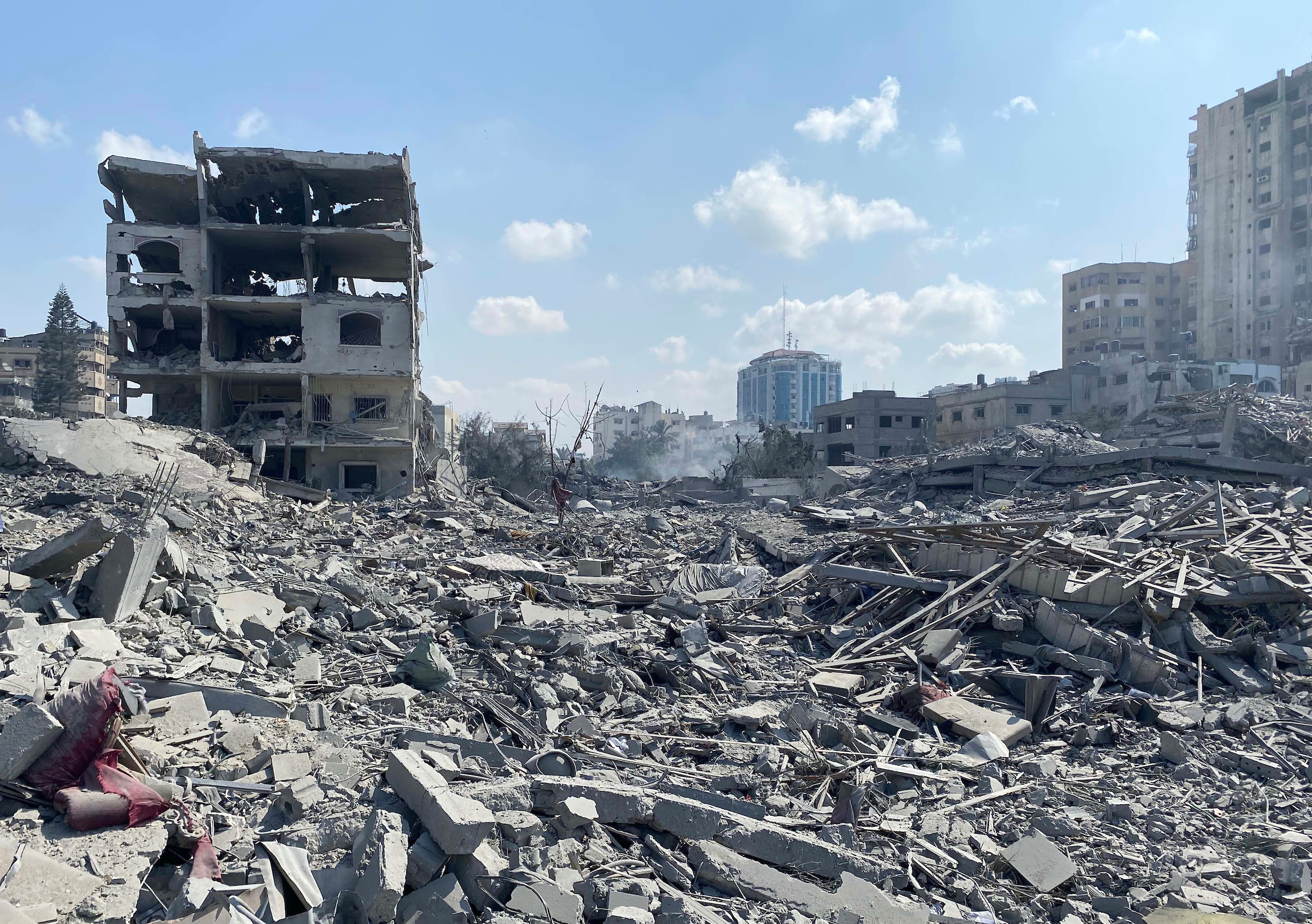
Image: The aftermath of an Israeli airstrike in Gaza City on October 9, 2023, leaving widespread destruction in the Rimal area. available at: https://commons.wikimedia.org/wiki/File:Damage_in_Gaza_Strip_during_the_October_2023_-_29.jpg