

Much like undergraduate students, many Marxists have a long-held aversion to statistics and quantitative social science. This aversion, at least among Marxists, is justified due to the supposed inability of quantitative methods to fully capture the attitudes, behavioral impetuses, culture, and political preferences of the working class. Specifically, quantitative methods—like public opinion surveys, regression analysis, etc.—which “mainstream” social science relies upon, is unable to fully register the breadth of class consciousness among workers, and the contextual forces that shape, hinder, and/or strengthen that consciousness. As a result, Marxist social scientific work—with notable exceptions, especially the work of the late Erik Olin Wright—tends to be relegated largely to theory, historical analysis, and qualitative (e.g., ethnographic) analysis.
We believe that this forsaking of quantitative analysis is unfortunate for many reasons, but two are worth emphasizing. First, it has given mainstream social science even more of a reason to ignore the substantive claims of Marxists, since, in methodological terms, we are talking past each other. Marxists do not attempt to meet mainstream social science on its own terms, which, if our critiques are to mean anything outside of the internecine, often petty squabbling within Marxism, should be the goal. Refuting the often-nonsensical claims of mainstream social science using their own methods, while being rigorous enough to be published in their own journals will not, in the short-term at least, save our claims from the academic periphery, but it will certainly do more than a refutation that rejects the methodological basis of mainstream social science as a whole. It is worth noting that Black Marxist scholars (especially W.E.B. Du Bois, Oliver C. Cox, and Abram Harris) throughout much of the 20th century followed this precise formula to shift academic debates on race in the United States: that is, beat them at their own game.
Second, Marxism’s forsaking of quantitative analysis has left many topics of historical interest to Marxists partially or completely unanalyzed. Ironically, it has left the answer to the question “what does the working class want, think, and demand?” almost completely to the mainstream. It has been non-Marxists who have used quantitative analysis to convincingly show that the supposedly backwards American working class is overwhelming supportive of largescale economic redistribution, generally disdainful of the rich, and class conscious. Given their lack of historical materialist analysis, these findings are rarely interpreted particularly convincingly, and their political implications are left undertheorized. The point, however, remains: Marxists find the employed method suspect, so there is little to no engagement. Perhaps even more ironically, Marxism’s rejection of quantitative analysis has left us unable to answer even the most basic questions about the growing acceptance of socialism in American politics.
A 2021 Fortune/SurveyMonkey poll found that 42% of Americans have a ‘somewhat’ or ‘very’ positive perception of socialism; that figure increases to 55% among Americans aged 18 to 34. Political candidates who identify as socialist have also found increasing electoral success. Senator Bernie Sanders, a longtime socialist identifier, won numerous states in the 2016 and 2020 Democratic presidential primaries (states, it is worth pointing out, which would then swing toward Trump in the actual election), while many socialist identifiers have been elected to national, state, and local office. At the time of writing, Zohran Mamdani, a socialist, seems likely to be elected the mayor of New York. Still, we know very little about the growing population of socialist identifiers in the United States, and how (or if) they differ meaningfully from liberals.
In our recent Critical Sociology article “What Do American Socialists Really Believe? Polarization, Ideology, and the Problem of Socialist Identifiers,” we sought to answer this question through a series of largescale (sample size of roughly 1,500), nationally representative surveys of Americans in 2023 and 2024. We found that a sizeable proportion of Americans self-identify as socialists (17%), and a roughly equal proportion were unsure (which is to say that only 64% of Americans identify explicitly as a non-socialist). This specific finding is important since all previous mainstream (e.g., Pew) surveys focus exclusively on respondent’s positive or negative perception of socialism, not if they are dedicated enough to identify as a socialist. This alone should hearten all but the most sectarian Marxist who might wonder if the respondents’ socialism is “really” socialism.
Mainstream analysis has also completely lacked any analysis of how socialist identifiers differ from non-socialists in their beliefs and political behavior. We found distinct differences between not only socialist identifiers and non-socialist as a whole, but between socialist identifiers and non-socialist liberals. We found this to be the case with regard to respondents’ attitudes toward economic redistribution, their attitudes toward class actors, and their attitudes toward race and immigration.
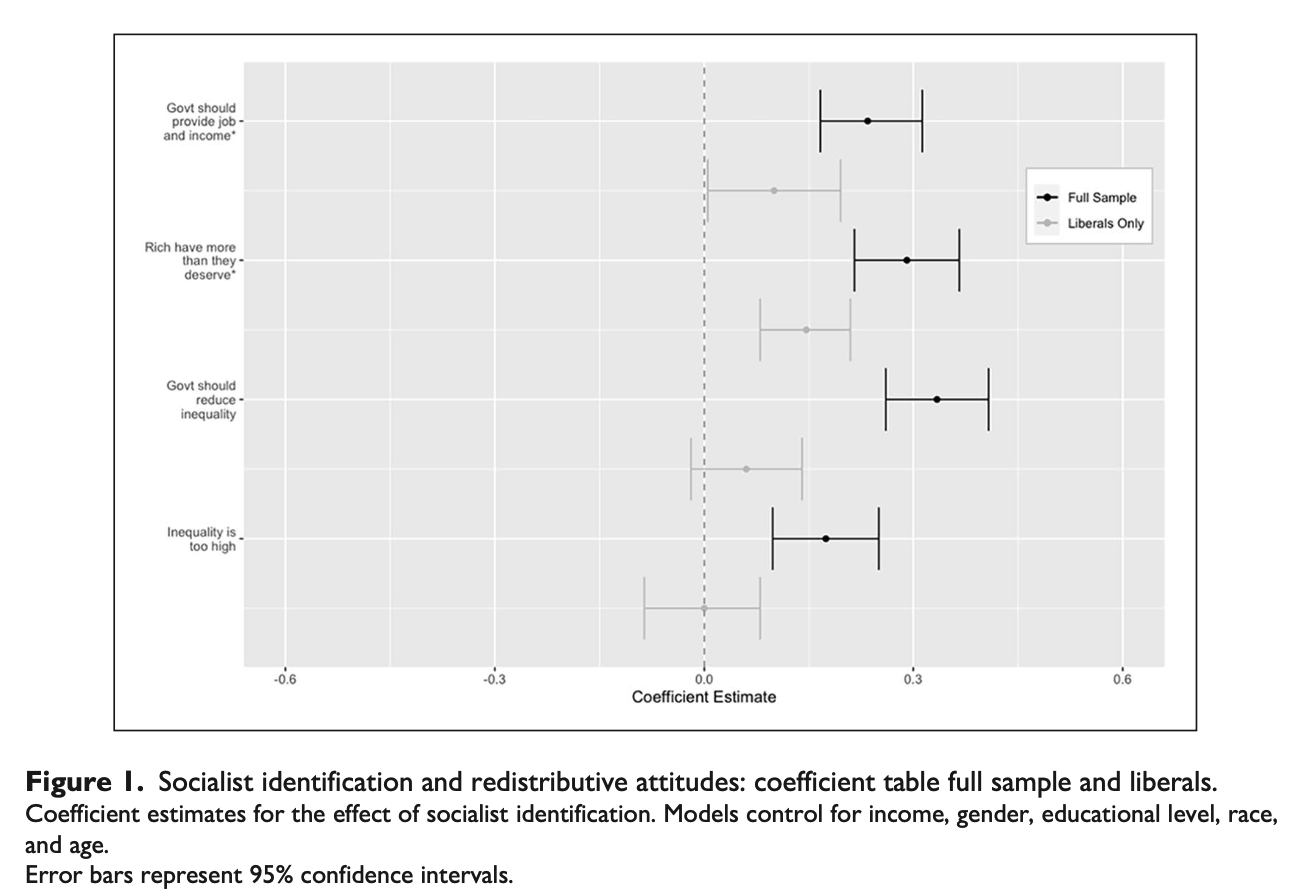
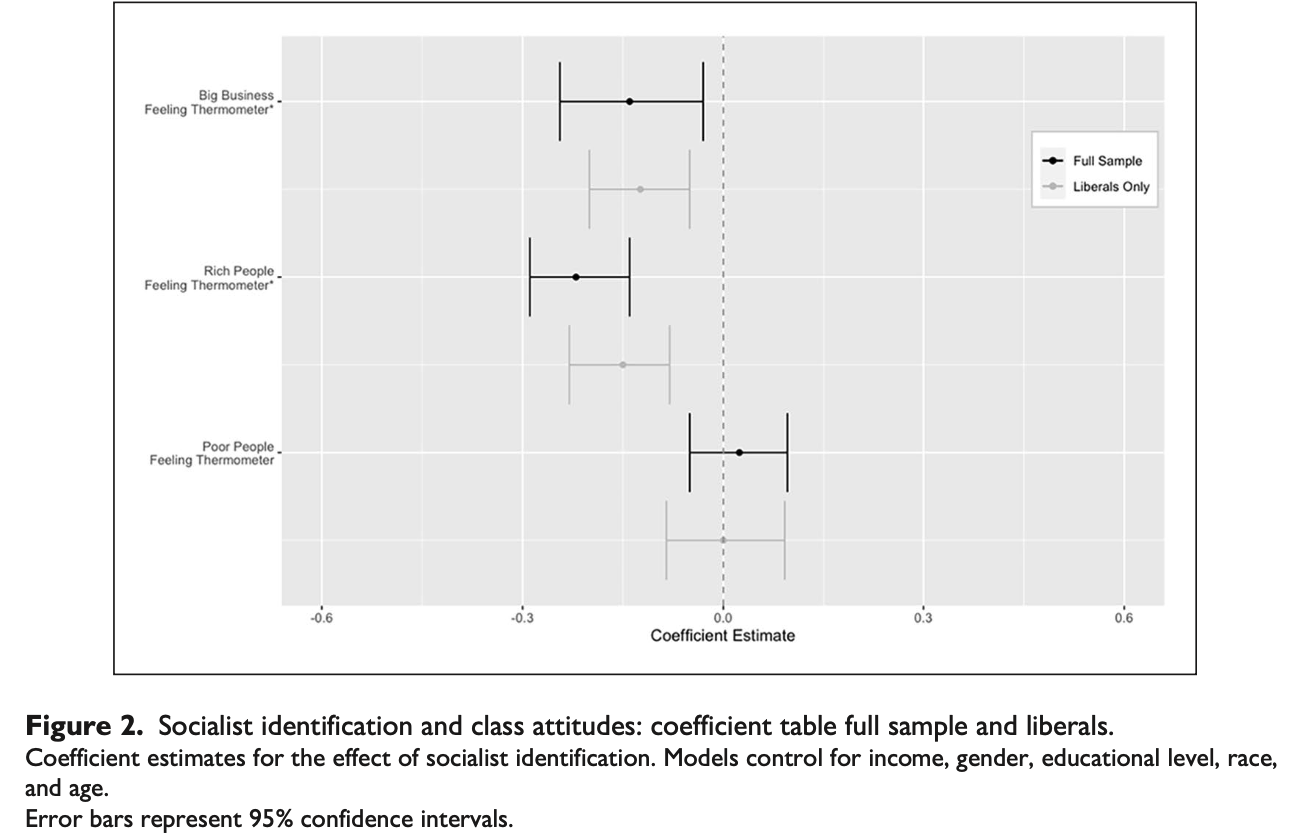
For instance, Figure 1 illustrates how socialist identifiers differ from non-socialists as a whole, as well as non-socialist liberals with regard to their attitudes toward economic redistribution. When compared to all non-socialists, socialist identifiers are far more likely to believe that the government should provide all Americans with a job and income, that the rich have more than they deserve, that the government should actively reduce economic inequality, and that economic inequality itself is too high. When compared singly to the mainstream American left (i.e., liberals), socialists still maintain far greater support for guaranteed employment and income, as well as perceiving the rich as undeserving. When asked specifically about their attitudes toward class actors, socialists are also distinct in their disdain of big business and the wealthy (see Figure 2).
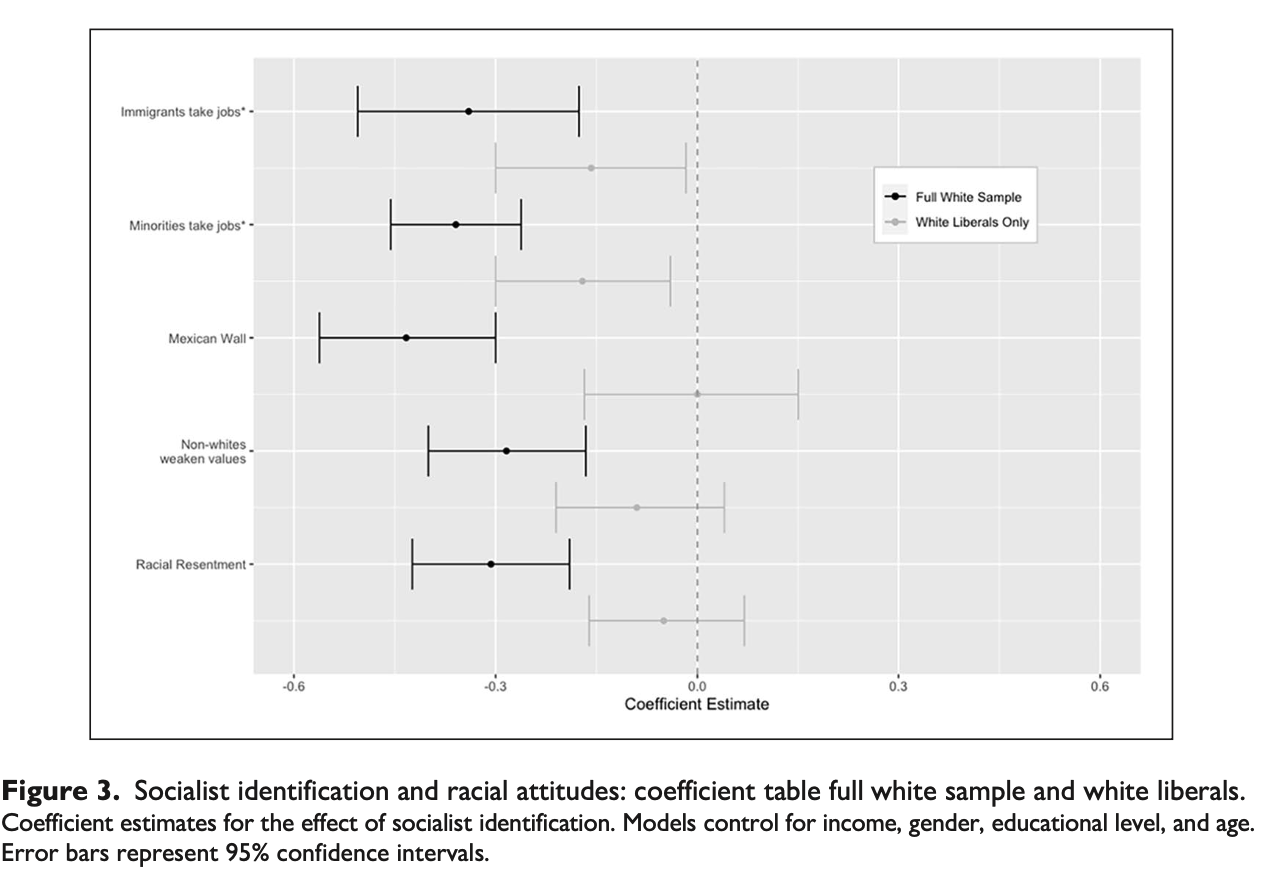
American liberalism after the Civil Rights movement of the 1960s has increasingly been associated with the pursuit of legal racial equality and the rejection of ideological racism. Indeed, the possession of progressive racial attitudes and the celebration of multiculturalism can be seen as perhaps the defining quality of contemporary American liberalism. Socialism, on the other hand, has been accused of subsuming issues of race into issues of class, ignoring the unique inequalities wrought by white supremacy. We might expect, then, that liberals adhere to more progressive racial attitudes than socialists. This, however, is not the case (see Figure 3). When the sample is limited to white respondents only, socialist identifiers are either more progressive in their racial attitudes compared to white non-socialist liberals, or their attitudes do not differ. White socialist identifiers are more progressive on every racial attitude included in the surveys when compared to all white non-socialists. They are less likely to perceive immigrants as those who displace Americans from their jobs, they are less likely to perceive minorities as displacing white workers from their jobs, they are less supportive of a border wall between the United States and Mexico, they are less likely to believe that non-whites weaken American values, and they are less racially resentful than white non-socialists. When compared to just white non-socialist liberals, white socialist identifiers are less likely to perceive immigrants as those who displace Americans from their jobs and less likely to perceive minorities as displacing white workers from their jobs. While white socialist identifiers and white non-socialist liberals do not differ on the symbolic aspects of racial ideology, like racial resentment or non-whites’ supposed effect on American values, they do differ in their perception of the effect of race on the US economy.
The evidence presented above suggests that not only do socialist identifiers differ significantly in their social and political beliefs from non-socialist identifiers in general, but they also differ significantly from those conventionally acknowledged as the beginning and end of the American ideological left: liberals. Socialist identifiers tend to favor a robust welfare state and state-led economic redistribution, they tend to resent the wealthy and big business, and they tend to have more racially progressive attitudes. These findings are significant for several reasons. First, while popular media has continually emphasized a growing embrace of socialist ideas in the United States, and the electoral success of socialist identifiers has unquestionably grown since 2016, this group has been largely ignored by mainstream social science and Marxists alike. The evidence presented here illustrates, for the first time, how socialist identifiers in the United States differ from non-socialists.
Based on: Melcher, Cody R., & Lindsay, Spencer C. (2025). What Do American Socialists Really Believe? Polarization, Ideology, and the Problem of Socialist Identifiers. Critical Sociology, 51(7-8), 1369-1382. https://doi.org/10.1177/08969205241281752
Cody R. Melcher is an assistant professor of sociology at Loyola University New Orleans, and an instructor in the prison education program at B.B. Rayburn Correctional Center.
Spencer C. Lindsay is an assistant professor of practice in the School of Government and Public Policy at the University of Arizona.
Image: Democratic Socialists of America jacket from San Francisco, Bernie Sanders Rally, LA Convention Center, Los Angeles, California, USA (49609093656).jpg. Wikimedia Commons