
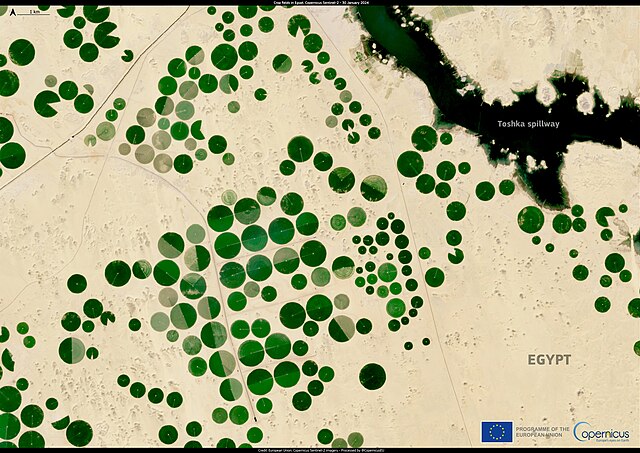
The sudden and dramatic world price hike in 2007-2008, and the near financial crash in the trans-Atlantic world, sparked fears in elite circles that prices would remain high and volatile. With global warming and depleting resources, especially fossil fuels, fears mounted of limits to commodity production.
Emerging from this climate of fear were calls for “Greening the desert” programs and policies. Water-efficient (and even water-less) agriculture in new and existing arid lands were presented as sustainable solutions to the problems of rising food insecurity as commodity prices continued to rise. Technical feats such a solar-powered irrigation systems with desalinated water and hydroponic methods that grow crops without soil would save us from multiple water crises as keys sites of commercial agriculture were drying up.
The Frontiers of Corporate Food in Egypt (Oxford University Press) traces these developments and shows how the expanding frontier of commercial agriculture into newer, often drier lands has been important to the growth of a corporate agri-food system in the country.
The book argues that frontiers have been necessary for the growth of corporate food because of the ecology of commercial agriculture. The loss of diversity between and within plant and animal species, and the tendency to degrade the top soil, water sources, and other natural resources, lead to vulnerabilities, which have multiplied and become bigger threats like the Avian flu and other infectious zoonotic diseases. These threats, in turn, push and pull agribusiness to new lands.
Agribusiness in Egypt includes large family business groups, multinational and transnational corporations, financial firms, and so-called entrepreneurs. These corporate actors are often vertically and horizontally integrated, agriculture and food being just one sector that they are invested in.
Industrial poultry warehouses, large-scale fruit and vegetable farms, food processing facilities, and more concentrate in the expanding desert frontier, to the west and east of the river Nile and the Delta. Industrial poultry, in particular, has led this movement ‘into the desert’ as threats from disease dictate distance from other farms and residential areas.
Commercial agriculture and food processing are both for the domestic market, including corporate food service (e.g., fast food franchises) and retail (e.g., hypermarkets), and for export to the Middle East and Europe.
This growth in the 1990s and 2000s has been incomplete but rapid. Take hypermarket sales (as a percentage of total grocery sales) during the first decade of the 21st century alone: rising from 13% in 2003 to an estimated 26% in 2011.
The development of a corporate agri-food system has resulted in multiple public health problems from the spread not only of infectious diseases but also of chronic diseases due to the change in diets across class to foods/drinks high in unhealthy fats, sugars, and sodium. These dietary changes in Egypt have mirrored changes in other middle-income countries as well as lower-income countries.
Also, a growing gap between winners and losers in agriculture has formed, as processors and retailers have made contracts with capitalized producers. Small-scale producers in villages in/near to the desert frontier supply to processors but often on an informal, ad-hoc basis.
The expanding frontier of corporate food in Egypt—and “Greening the desert” programs and policies around the world—involves land reclamation, a timely, often expensive process of transforming the land to make it suitable for commodity production.
Why is this transformation expensive? The land may be under water, or grossly uneven, or far from irrigation sources. The land may be degraded or eroded. In short, the land is not yet arable and is transformed to become so.
The Frontiers of Corporate Food in Egypt shows that land reclamation is a particular type of commodity frontier in historical capitalism, distinct from frontiers that have required little investment to make them profitable. This type of commodity frontier differs from, say, resource frontiers, as Jason Cons and Michael Eilenbergdelineate, or Jason W. Moore’s ‘cheap fix’ frontiers that need little more than an axe and hoe.
Land reclamation in the current world food economy has become even more expensive. Global food retailers and third-party certifiers place extensive biosecurity protocols on production and distribution. These protocols for protecting investors and consumers from the many vulnerabilities and risks associated with commercial agriculture make reclaiming the land all that more of an investment.
Taking the longue durée perspective, the book demonstrates how reclaimed lands have been central to capital formation in land, from the late medieval period in western Europe, as feudal estates fell apart, to the unravelling of the tributary system in Ottoman Egypt by the 19th century. These proto-capitalist states took an existing state practice—conferring rights and displacing costs onto individual men or groups to reclaim the land—and gave the reclaimed land a new point and purpose, i.e. commodity production for a return on investment.
In historical capitalism, reclaimed lands as a commodity frontier have continually expanded, from coastal lands to marsh lands to now arid lands.
Will Martian lands be next?
Marion Dixon teaches at Point Park University in Pittsburgh, PA. She has been researching agriculture and food for more than 15 years. You can find out more about her work at: https://marionwdixon.com/.
Image: Copernicus 2024-02-03 via Wikimedia Commons (CC BY )