
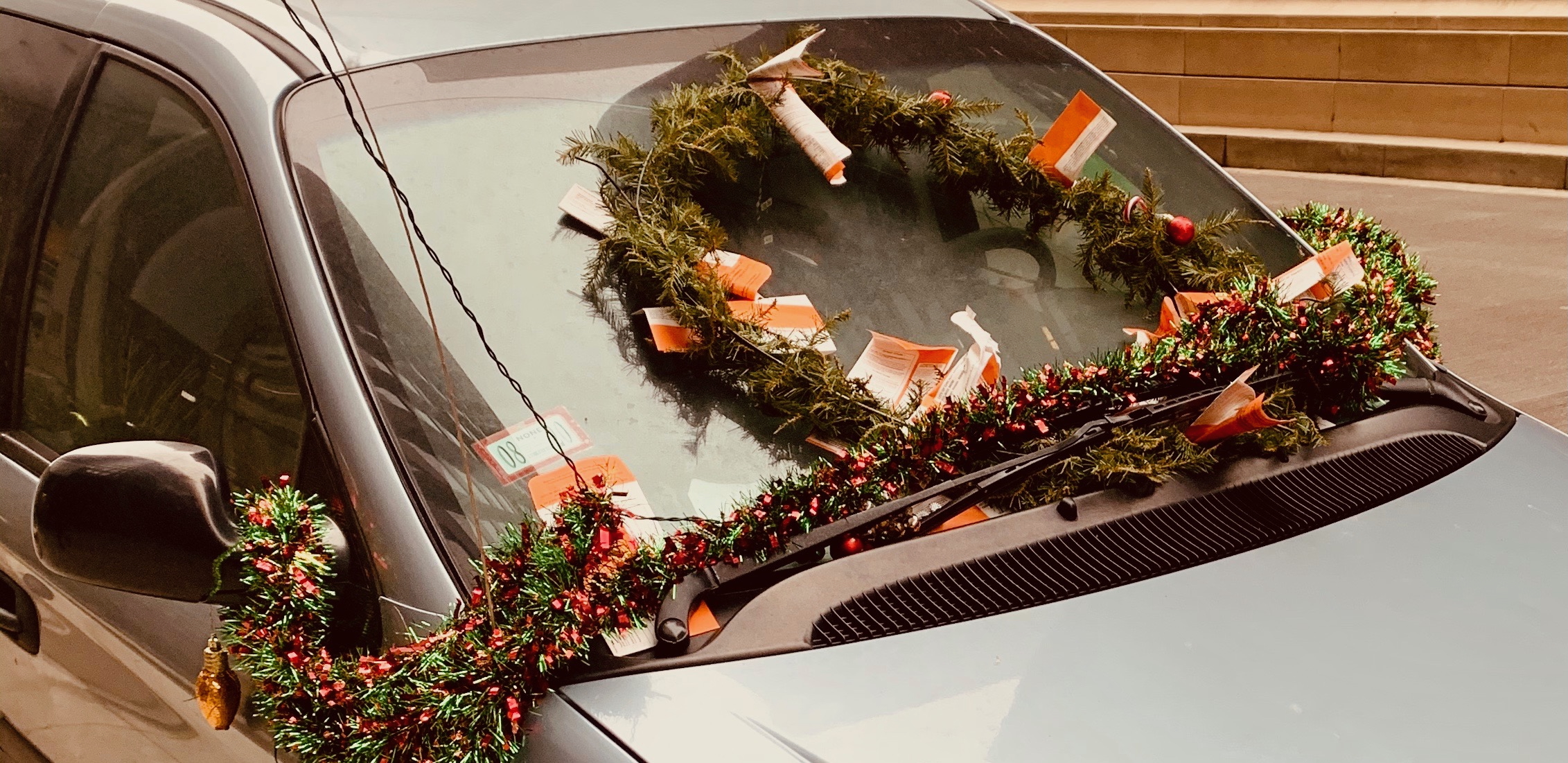
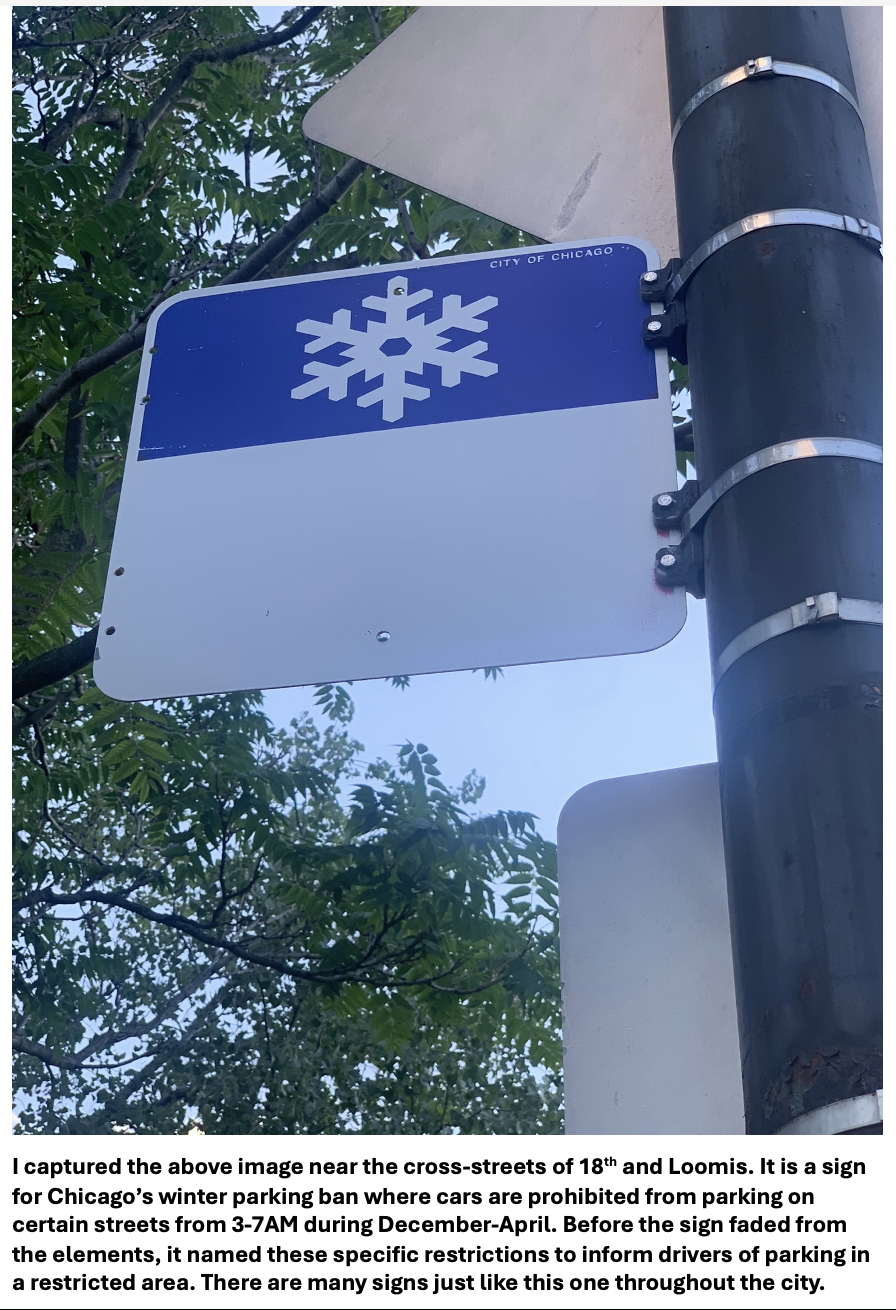
Meet John Biggs. On December 1, 2022, he awoke to discover his car gone. As a carpenter who keeps tools in the trunk, no wheels meant no work. No work meant no income. No income meant problems. Later Biggs would learn his car towed on the 1st day of the winter ban. The restriction’s supposed to keep snow off the roads. There was no accumulation. There were no signs on the block that said parking was prohibited. Even the closest one a block away was no help. The words were unreadable, faded from the elements. It’s a typical sight to see in Chicago.
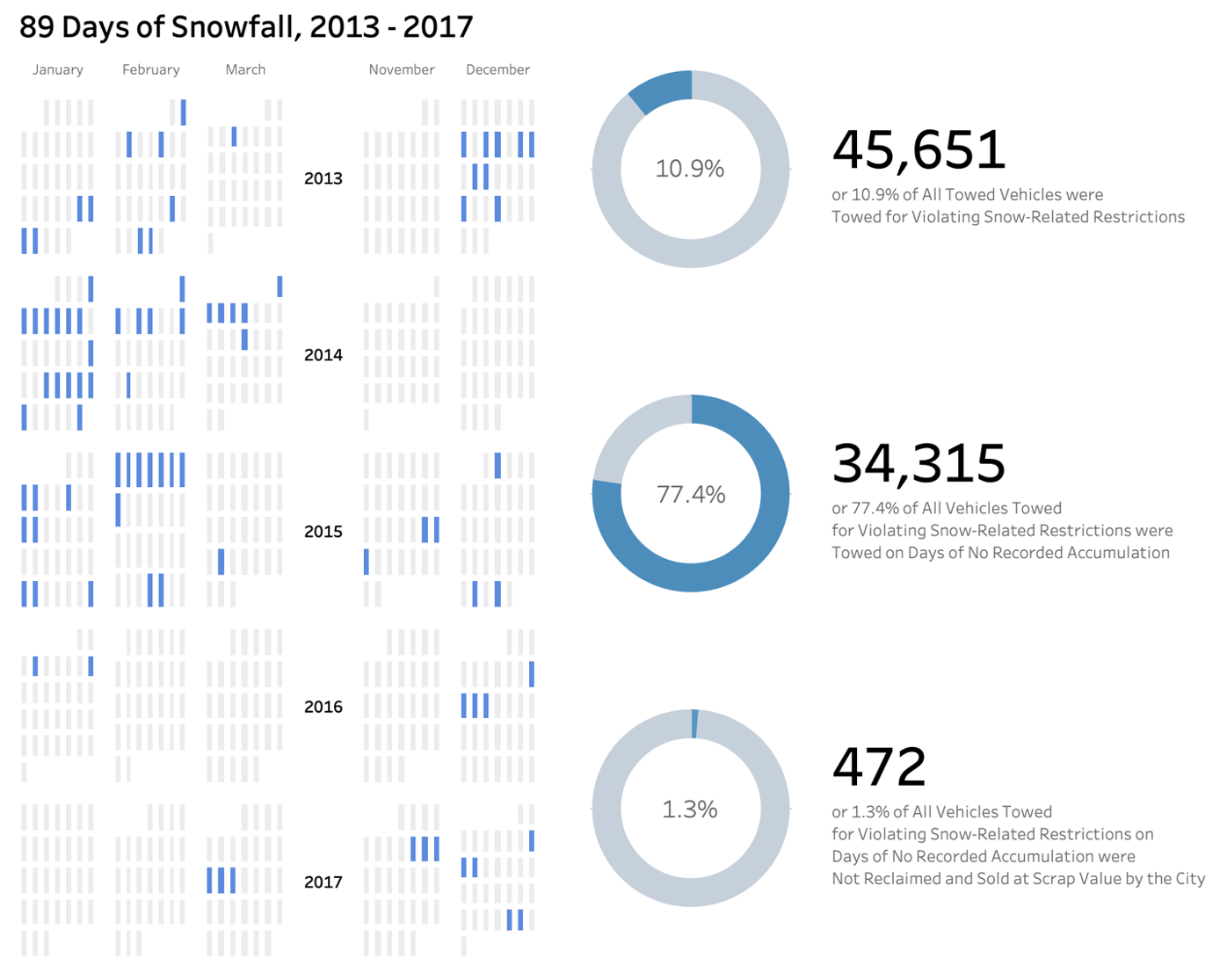
The thing is there’s not just one John Biggs in Chicago. There are many. More than 9,000 cars are towed every year for snow-related restrictions. Less than 1-in-4 occur on days of actual accumulation. About 1% of these tows are never reclaimed. In other words, what happened to John Biggs is hardly unique. It’s a common experience that provides a lens for interrogating one of Chicago’s first attempts at privatization, theorizing how racialized hardships result from draining neighborhood resources and quantifying which communities are subject to debt and dispossession.
Towing-related debt inconveniences some, but it devastates others. That’s because some can dutifully satisfy what they owe with disposable income. Others experience debt as another problem stacked on top of a broader crisis of precarity.
Let me walk you through how fast this debt spirals out of control with ballooning late penalties, rolling fees, and collections costs. (Alternatively, you can walk through this simulation on your own with this dashboard.) When someone’s car is towed for snow-related reasons, that person can be subject to a $60 parking fine, a $150 towing fine, and a $20 daily storage fee for impoundment. The initial debt stands at $230.
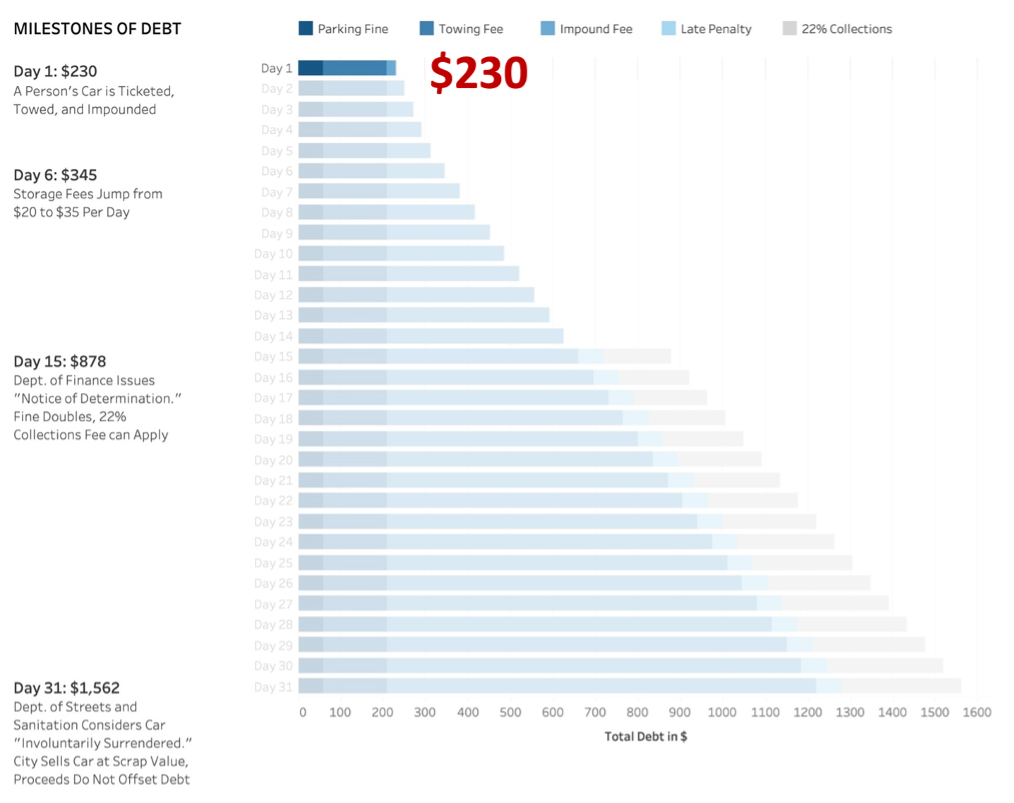
Should you not make good on your debt, which means making a full payment or setting up a payment plan, a person’s car stays at the pound. There, it racks up storage fees with each passing day. On day 6, storage fees jump from $20 to $35 per day. After less than a week, you now owe the city $345.
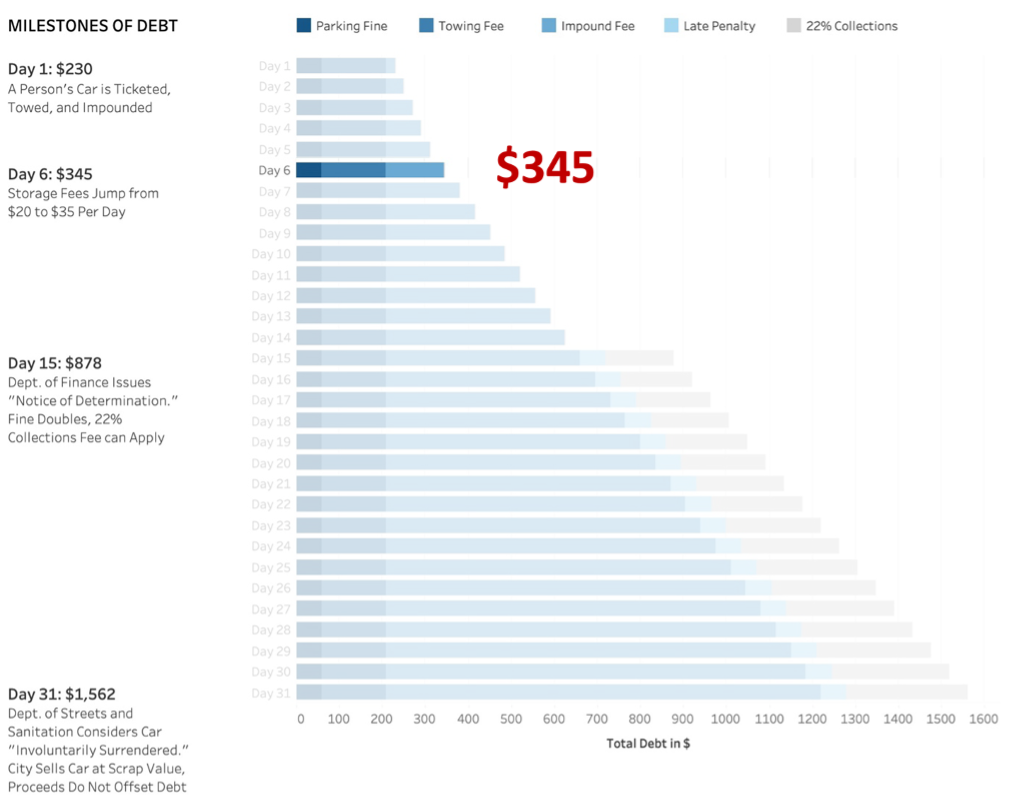
When drivers fail to pay their parking tickets in 14 days (or setup an appeal in 21), regardless of the reason, Chicago’s Finance Dept imposes a late penalty. The original fine then doubles from $60 to $120, and a 22% collections fee can be added to what you owe. The debt now stands at $878.
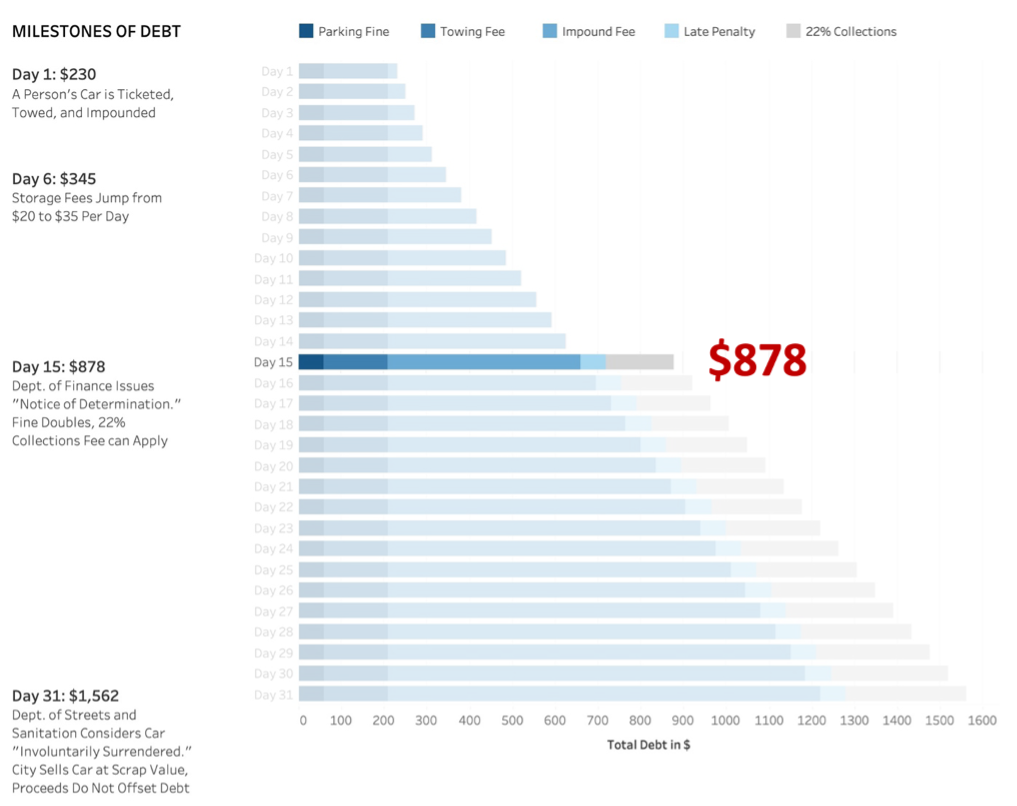
When Chicago adds a 22% collections fee to the debt, most of this money goes to privatized debt collectors like A & O Recovery Services, Arnold Scott Harris, Linebarger Attorneys, and Linebarger Goggan Blair & Sampson. These firms make about $15,000,000 each year recovering all kinds of debts for the city.
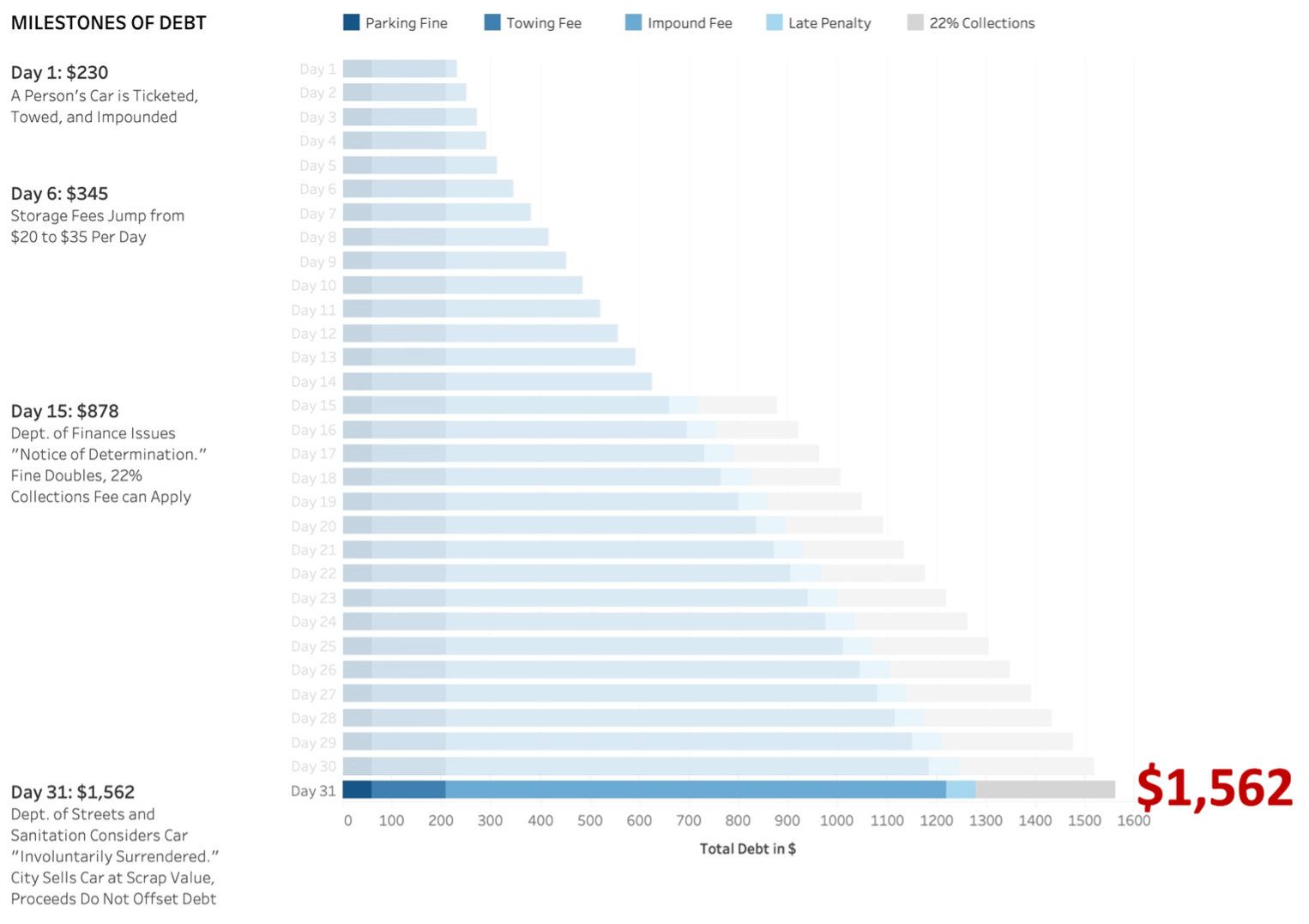
Within 10 days of impoundment, Chicago’s Streets & Sanitation lets you know via certified mail they have your car. Three weeks after the confirmation of receipt, the city considers your car to be “involuntarily surrendered.” It’s a nicer way of saying “plundered,” I suppose. Once your car has been involuntarily surrendered, the city then has legal ground to dispossess you of your car. Meanwhile, you go from owing $230 to $1,562 in 31 days.
And now, you don’t have a car.
To make a bad situation worse, there is no statute of limitations on ticket-related debt in Chicago. It follows the common law doctrine of nullum tempus occurrit regi, a Latin phrase that translates as “no time runs against the king.” That means the meter on unpaid parking tickets never runs out of time. With no statute of limitations, the City of Chicago claimed as much as $1.45 billion in outstanding ticket debt as of 2017.
After Chicago dispossess and claims ownership of your towed car, the city auctions it off at scrap value. We’re talking $100-200 regardless of the make/model/condition. Chicago-based journalist Elliott Ramos did a deep dive on this practice, estimating (with a very conservative methodology) that most sell for 1/5 their value. You can read his investigation here: https://interactive.wbez.org/brokentowing/.
Who buys these cars? The same company that towed most of them: United Road Towing. Less than two months into his 1st term as mayor, Richard M. Daley offloaded the city’s tow services to this company in 1989. The company was created just 9 days prior to landing the prized contract, and one of the co-owners (Martin McNally) had close investment ties to the mayor’s top adviser Jeremiah Joyce. According to Rich Daley’s biographer, Joyce was not only known for his personality of a Doberman pincher but his opportunism for leveraging political connections for investment opportunities. Nearly four decades later after first privatizing Chicago’s towing services, United Road Towing has monopolized the contract ever since.
Now United Road Towing is among the largest dispatchers in the world. It’s a politically connected company too, beyond a handful of people closely connected to the mayor’s office. I looked at campaign contributions the firm and its Board of Directors made between 1994-2022 – the most currently available data at the time of this study. The list of recipients amounts to a “who’s who” of Illinois-based politicians.
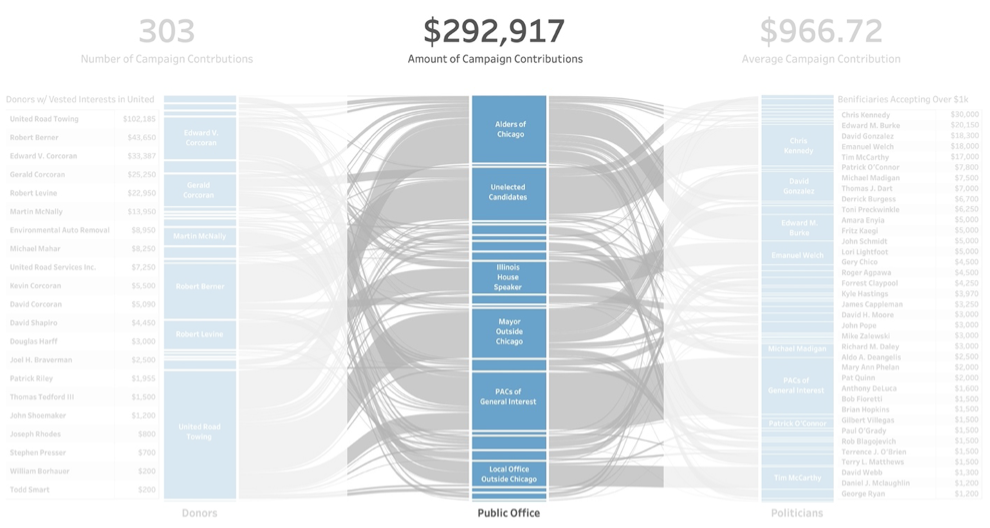
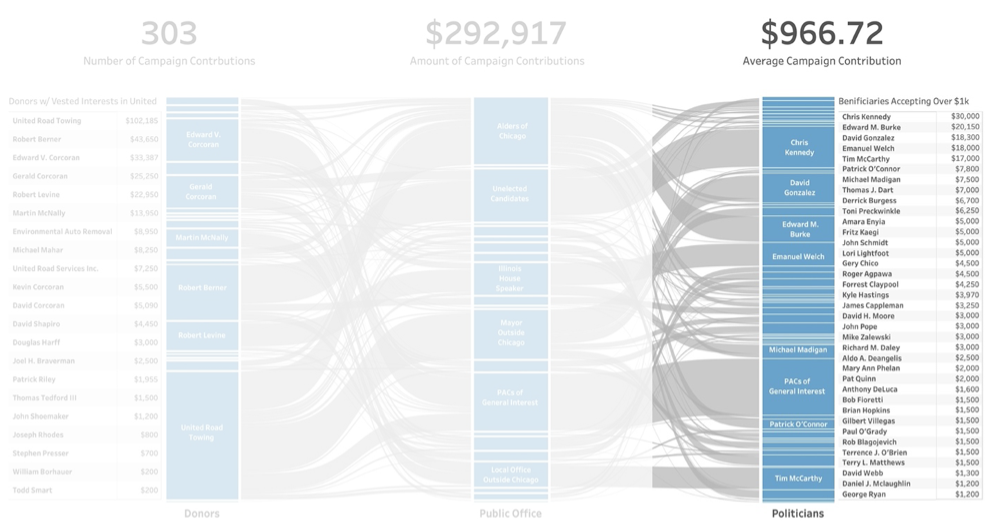
Though contributions from United Road Towing do not automatically translate into political action, they align with Chicago’s deep history of corruption where coveted contracts are exchanged for campaign dollars. What you’re looking at in the adjacent figure is a 3-level Sankey diagram that visualizes the flow of campaign contributions made by United Road Towing or one of its Board of Directors. (An interactive version is available as a dashboard.)
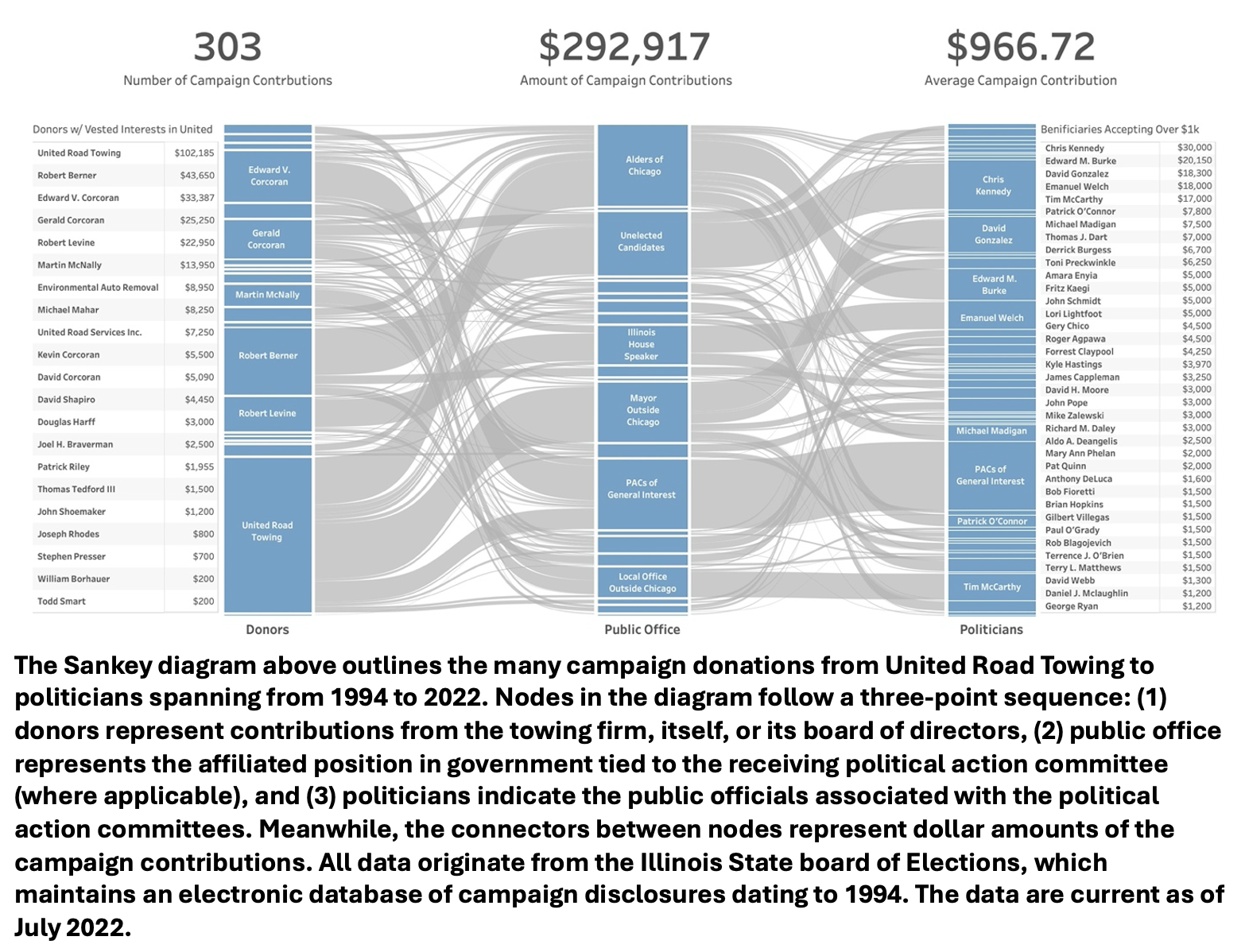
United Road Towing and its Board members made more than 300 contributions totaling nearly $300,000 to over 100 political actors throughout Illinois. On the left of the diagram, you’re seeing who made the donation on behalf of the towing firm. I’ve “named names” so you can identify the top donors.
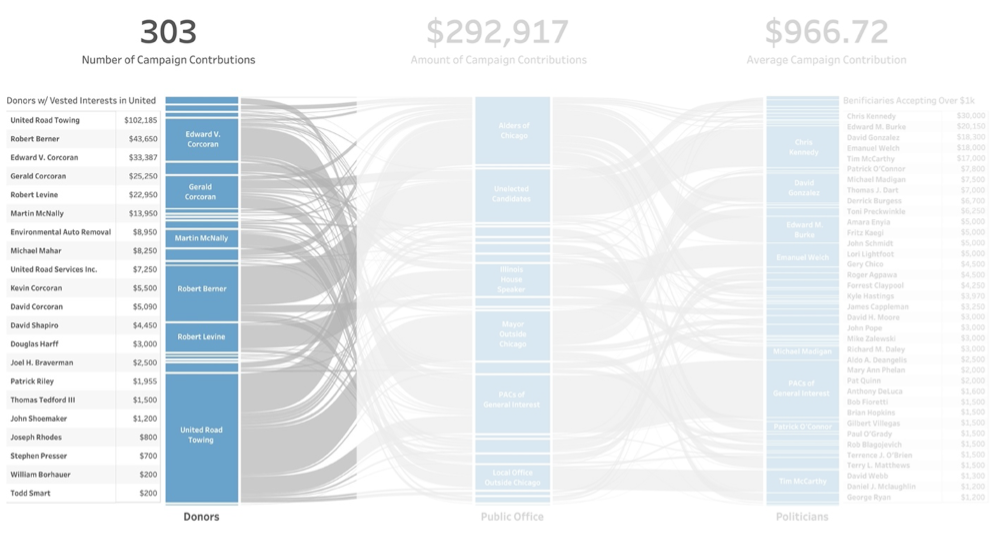
In the middle of the diagram, you’re seeing the affiliated political office for these contributions. These offices are far from random. They include Illinois House Speaker, Mayor of Chicago, and many alderpersons City Council. Upon closer review, you’ll see that many of these alders hold key leadership positions (e.g., Floor Leader, Finance Committee Chair) that define the legislative agenda.
On the right of the diagram, you’re seeing the beneficiaries of these contributions. Again, I’ve named names. They include a few who have been implicated in recent federal convictions related to political corruption (e.g., Ed Burke, Michael Madigan).
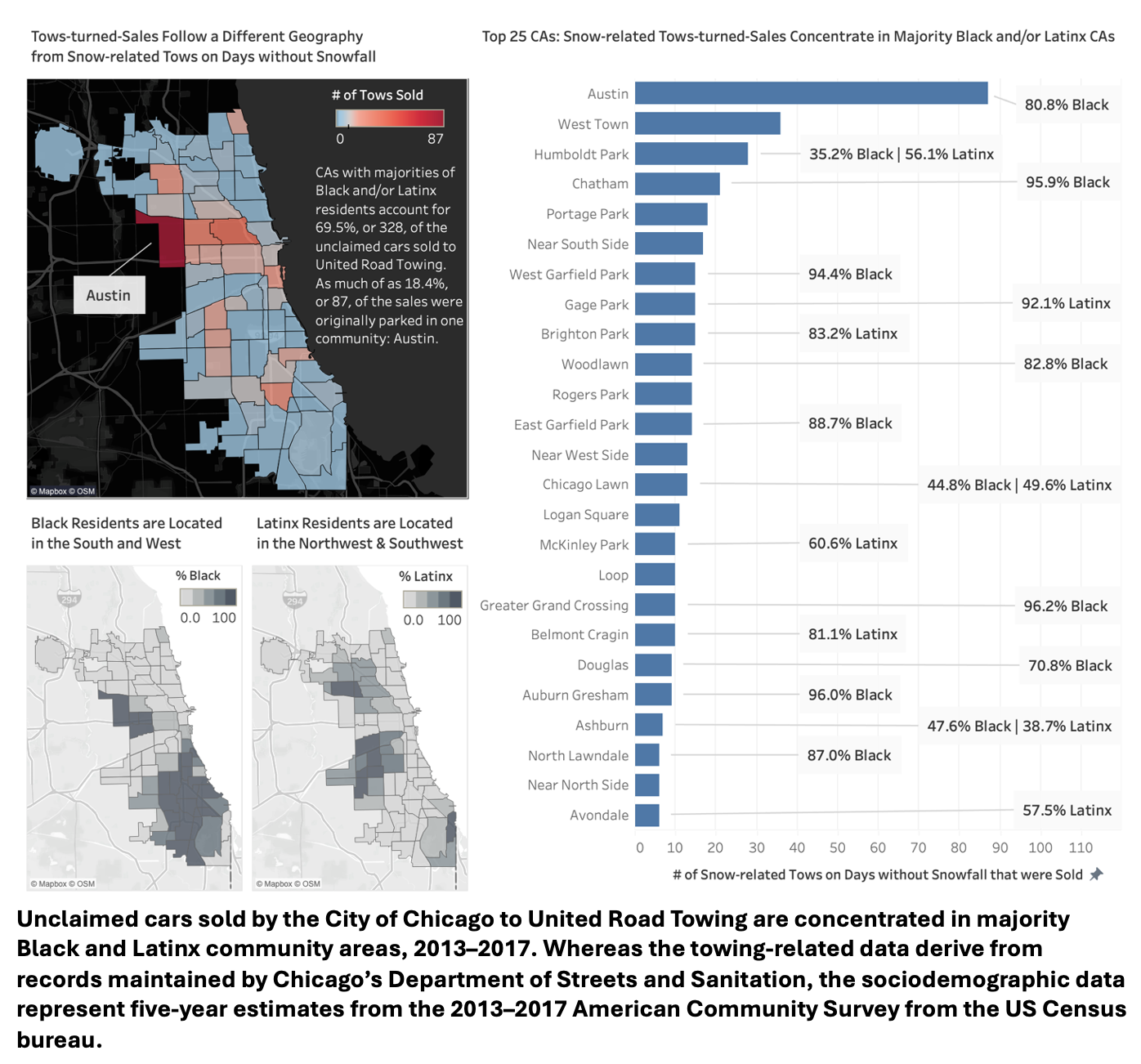
Where were the cars that were sold to United Road Towing originally parked? Over 2-in-3 dispossessions were parked in Chicago’s majority Black or Latinx communities. (Don’t just take my word for it. Play around with the data in this interactive dashboard.) John Biggs’ neighborhood of Austin had the most dispossessions. It’s the same disinvested space where previous Mayor Rahm Emanuel 4 of 50 schools in 2013. Emanuel shut these schools down just after serving as Barack Obama’s White House Chief of Staff but before being appointed as Joe Biden’s U.S. Ambassador to Japan.
The pattern of dispossession, here, is worth extra emphasis. Whereas theories of punishment often discuss the punished like they’re “surplus” populations or “urban outcasts,” the implication is that they stand outside the economy. I draw from the predation framework developed by sociologist Joshua Page and Joe Soss to highlight how racial precarity can be – and often is – leveraged for profitability. I extend their theory to euphemistically named public-private “partnerships,” where privatization grafts a profit motive onto city services while towing debt becomes a “wedge” for dispossession.
Kasey Henricks is an Assistant Professor of Criminology, Law, and Justice at the University of Illinois at Chicago and a Visiting Scholar at the American Bar Foundation. Looking to often overlooked objects of the everyday, from parking citations to lottery tickets, his research uncovers how race and class inequalities are reproduced through reconfigurations of public finance under late capitalism. Contact can be directed to him at kaseyh@uic.edu.
“Slush of Chicago” represents a brief summary of the article “A city so cold: parking on the streets of public–private predation” published in Race & Class and co-authored by Kasey Henricks and Diego Taboada. It was awarded the 2025 Outstanding Marxist Sociology Article Award by the American Sociological Association. The article is available at: https://doi.org/10.1177/030639682412741.
Photo Credit: Kasey Henricks